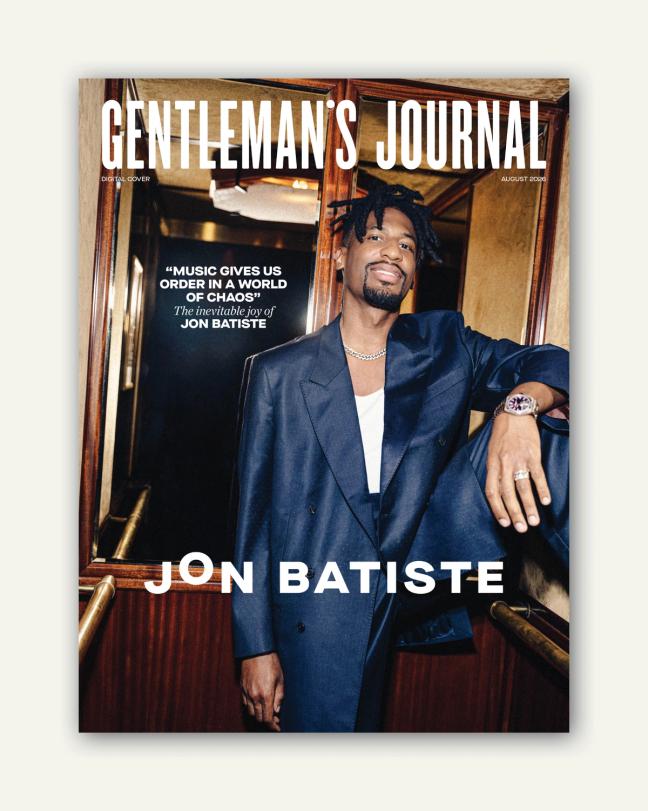
“Music gives us order in a world of chaos” The inevitable joy of Jon Batiste
As he finishes a historic four-night residency to celebrate 125 years of KOKO in Camden, the singer and composer talks meaning, ego, and the power of listening.
- Words by: Joseph Bullmore
- Photography: Noah Sapon
- Assistant: Jethro Sapon
- DOP: Max Kessell
- Stylist: Tim Brooks
- Groomer: 5ive
- Location: KOKO London
Jon Batiste makes a new playlist almost every single day — a selection of songs that somehow captures the mood of the moment, as it is or as he might want it to be; a soundtrack for a morning at home, or for a dash to catch a flight on tour, or perhaps for just before a Zoom interview with a magazine in which he is asked again to put into words what frankly he has explained a thousand times with his own songs already. Who was it that said that writing about music is like dancing about architecture?


Batiste pulls out a few tracks from his playlist for today as we speak: ‘Human Nature’ by Miles Davis; several songs by a singer called Jackie Evans; a whole album, pretty much, from New Orleans jazz clarinetist Alvin Batiste (no relation.) He could go on. Batiste has a deep, deep pool of musical references to draw from. His own performances are suitably genreless. There is a viral clip on the internet that surfaces in my feed pretty much weekly, of Batiste playing the piano on CNN for host Chris Wallace, and transmuting Beethoven’s Fur Elise from its classical form into the blues and then into gospel and then back again, in the shimmer of his fingertips. As striking as the music is the way he laughs just at the end of the trick, and as Chris Wallace says, wide-eyed, “that is amazing.” “Oh, that’s just messing around,” Batiste says back, his New Orleans accent filled with musicality itself. But it’s this easy genius for which Batiste is known and loved — as the former bandleader of The Late Show with Stephen Colbert; as the co-composer of the incredible score for Pixar’s Soul; and as the multi-grammy winning performer and pianist; the industry darling who nonetheless seems about as uncynical a success story as you can imagine.
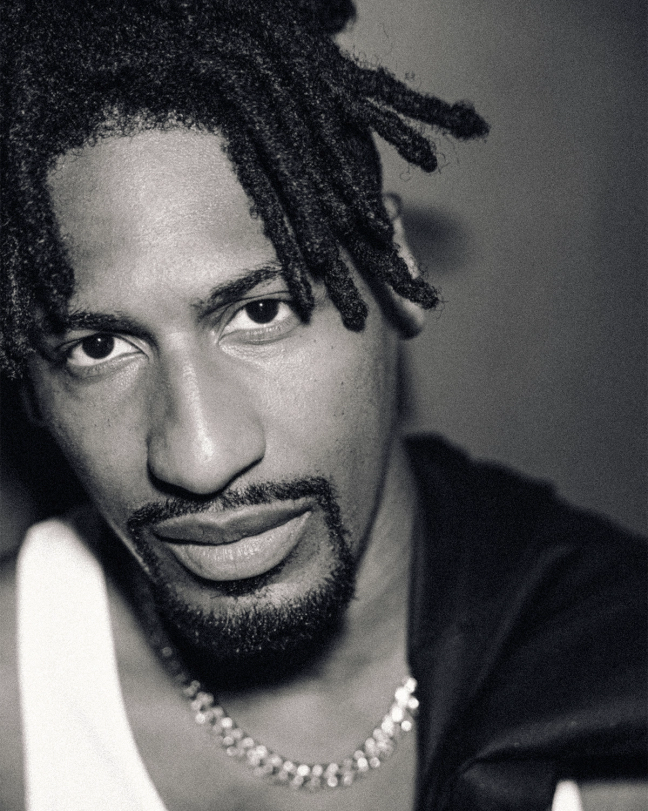
You would call him chameleonic, somehow, but that isn’t quite the right phrase: chameleons change themselves based on their background; Batiste seems to stay exactly as he is, while the rest of us change around him. People I know speak of his concerts — a heady, symphonic mix of classical piano, jazz improvisation, and soulful crowd involvement — in often broken tones. Batiste mentions, with a sense of small wonder, how he has heard from audience members at the end of concerts who tell him that “it was the most significant experience of their life”. Not musical experience or concert experience — experience full stop. A lot of them mention a sense of strange and sudden connection with family members, living and dead, across the generations. He writes back to them when he can, he says. “I just have to respond to some of these incredible stories people share.”
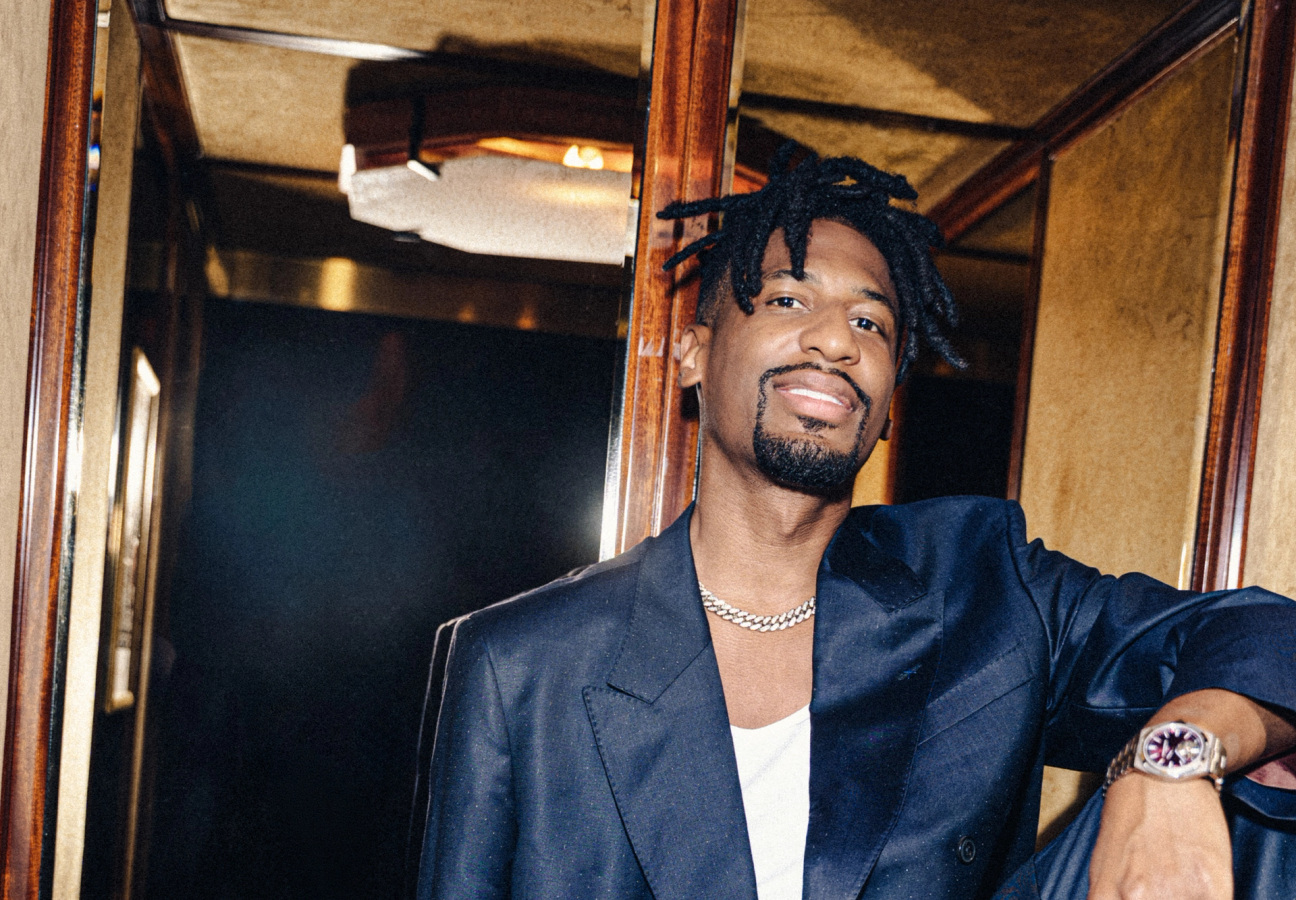
On a Friday evening at the end of June, at the height of an eerie heatwave, Batiste played the third session in four-concert residency at KOKO, Camden’s historic music venue, which was packed to its baroque rafters with people intermittently swaying, smiling, and interacting, in a highly non-London way, with the audience members around them. About halfway through the main performance, as Batiste brought out the melodica — the strange, pipe-piano children’s toy that is central to so many of his performances — I realised that no-one was holding a phone aloft to try to capture it all. This felt a minor miracle in itself.
The residency was in town to celebrate the 125th birthday of the Victorian venue — a rolling party that extended long into the night with a series of late night jams and impromptu performances, helmed by Batiste and vocalist Michael Mwenso. These unfurled at Ellen’s — the intimate jazz bar hidden away somewhere inside House of Koko, the venue’s wonderfully esoteric members club. They had the sense, fittingly, of taking place in another decade entirely.
Down in the main venue, it was a busy stage. Along with Batiste’s expansive house band — each of whom took a riotous solo under the spotlight — he was joined by Corinne Bailey Rae (who sung a soaring duet with him of ‘Moon River’) the Autistic Adult Choir, and Jamison Ross, the singular multi-instrumentalist, who at one point burst into a mesmeric crowd-backed performance of ‘Yesterday’.
What united all those people on that stage at KOKO? “Everyone has a generosity of spirit and a real deep soul,” Batistse says now. “But there’s also this real craft, of studying what I call ‘Rosetta Stone’ music — music that’s not necessarily in the cultural ether.” But crucially, he says, “they’re not snobbish or egoistic about it. It’s a group of people who have a level of craft and skill that’s genius-tier — and yet also have the ability to communicate that to anybody they meet. That’s very rare to find.” Perhaps one of the curious tricks of a Batiste concert is that, midway through, you start to feel like a better singer yourself.
I ask Batiste about the quote that opens the 2022 Netflix documentary about him, American Symphony. The film follows a remarkable moment in his life: a twelve-month period in which he became the most nominated artist at that year’s Grammy ceremony with eleven nominations, five of which he won. But it was also a time in which his wife, the writer Suleika Jaouad, was re-diagnosed with leukemia and underwent a grueling bone marrow transplant. The quote I was thinking of is this: “We don’t like music because it sounds good; we like it because it sounds inevitable”.

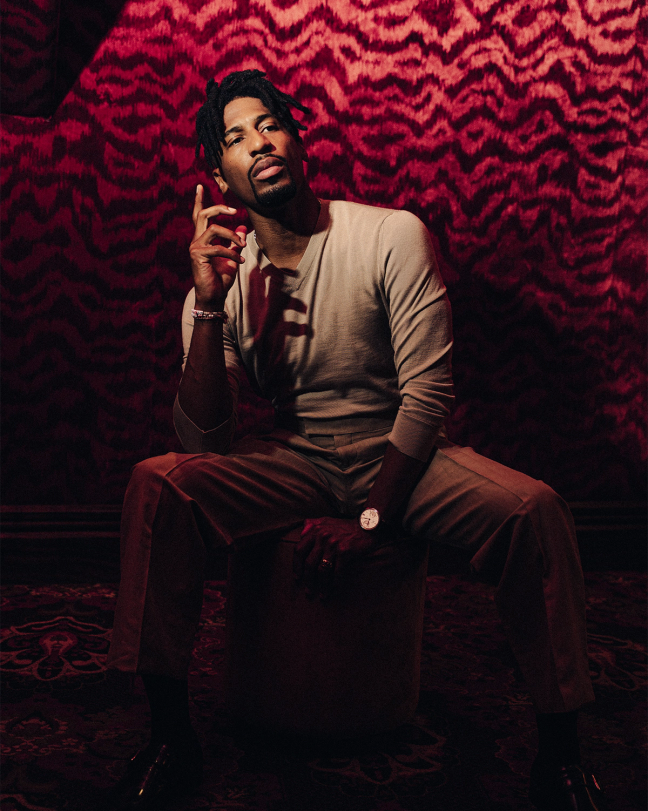
Shop the look: BRIONI jacket, £5,840; trousers, £2,920; SUNSPEL T-shirt, £95; CHEANEY shoes, £495; OLIVER PEOPLES sunglasses, £426; TUDOR watch, £2,610.

“What I meant by that,” he says now, “is that it sounds like the only thing that could have been; it’s been there all along, and it expresses itself in that manner that feels inevitable; and that’s exciting, because it gives us order in a world of chaos; it puts our inner life in order.”
A scientist would tell you similarly that music satisfies the human brain’s obsession with pattern recognition — our love or repeated themes and motifs, which has marked our species’ existence forever, from the turn of the seasons to the cycle of tides. (The earliest known musical instrument was a flute made from a vulture bone some 40,000 years ago.) And also how a certain sense of ‘inevitability’ in musical pieces powerfully triggers our highly-attuned anticipation-and-reward systems. In 1956, a musicologist called Leonard Meyer wrote a book called Emotion and Meaning in Music in which he explained how the inherently repetitive nature of music primes our brains to sense that something is yet about to change; that a variation on a theme will surely come. “We believe that the composer is not so illogical as to repeat the figure indefinitely,” he writes. And so when the change does indeed arrive, we feel immensely rewarded. “The greater the buildup of suspense, of tension, the greater the emotional release upon resolution.” Anyone who has experienced a cathartic, soul-lifting ‘drop’ will know about that specific “emotional release”.
But Batiste also intimates that music goes deeper than mere chemical reward systems; than simply patterns and resolutions. To him, it seems to closer mimic, or express, or channel (the words here are not quite right, and perhaps that’s half the point) our innermost emotions better than almost anything else. The seventeenth century composer Marc-Antoine Charpentier said that F minor is “obscure and plaintive.” Beethoven would describe B minor as “black or dark.” Mahler wrote how an F# major triad was marked by “profound, tearing grief and anguish.” My childhood piano teacher once told me that most rivers flow in major keys, and thus we associated major keys with hope and happiness, in the same way that we associate water with life.
"It's like things that make you cry every time you hear them; things that make you dance every time you hear them,” Batiste told NPR in 2024. “It's just something in the DNA of that sound."


“And that’s what music speaks to — the language of the invisible,” Batiste says now. “It speaks to the world that is within us, the language of the soul, and the language of things that are a part of our daily understanding of how we move through the world and see other people and process emotions and feelings.” (My mother has always had a quote from the ballerina Margot Fonteyn pinned to her fridge: “I explained it when I danced it.”)
And so the real power, perhaps, comes not simply when a song expresses something inexpressible within us; but also when it seems to put that inexpressible thing in some sort of order, Batiste says. “For something to feel order in that realm is very powerful. It is one of the closest evidences of God, as well. Wow — there is a meaning! It makes you feel that, among all the chaos, there’s meaning.”


Growing up in New Orleans, Batiste says he was “always listening”, and that he didn’t really speak until the age of ten. This allowed him, he thinks, a much closer and more honest sense of himself than most of us are afforded. “We don’t sit in silence anywhere near enough,” he thinks, or allow ourselves to listen to what we really want. Batiste has worked a lot with Rick Rubin, the legendary producer and creative guru, at his Shangri-La studios. One part of Rubin’s sprawling philosophy is that we need to simply listen to what some higher notion of creativity — or god, or the universe, or whatever you want to call it — actually wants, and then simply channel that into the work with no obstructions or pre-conceptions and as little ego as possible. When Batiste is in “that state of flow,” he says it really does feel like something or someone else is in charge. He can go for literal days in that state of receiver, conduit, “or vessel, but that’s not quite the right word”, he says — “sometimes you have to remember to eat.” I ask him what he says to his bandmates just before he goes on stage. “More of God, less of me.”
Batiste seems to be able to tap into that grand something-else with remarkable ease and fluidity. As he is thinking and talking, his fingers will sometimes begin playing music on the piano, or drumming on whatever surface is at hand. “When you’re inspired in that way, it’s like a clue,” he says in that CNN interview while his hands glissando up and down the keys. “That’s telling me more and more what it wants to be. The key is to listen, and just be the vessel to what comes through.”

Those initial ideas, he says, come when “you’re reading, or walking down the street, or you might be asleep and it comes to you in a dream.” Or perhaps from listening to something on his playlist that day. That’s not as simple as art inspiring art, I don’t think, though undoubtedly that is happening here as well. It seems more that things that are somehow true or pure or simply great often trigger some sort of reaction in the brains of those who are really receptive to them. I am thinking of the story of Haruki Murakami, the great Japanese novelist, who had no real inclination at all to write books — until, one April day, aged 33, he was sitting watching a baseball game in the sun, and one of the batters struck a terrific home run. “The satisfying crack when the bat met the ball resounded throughout Jingu Stadium,” Murakami later said. “Scattered applause rose around me. In that instant, for no reason and on no grounds whatsoever, the thought suddenly struck me: I think I can write a novel. I can still recall the exact sensation. It felt as if something had come fluttering down from the sky, and I had caught it cleanly in my hands.” I wonder, in all the stories Batiste hears about people’s remarkable reactions to his shows, how many are on the lines of: “I suddenly realised I should write that poem/ take up carpentry/ become a tree-surgeon/ dust off my paintbrush.”
I like that Murakami story because it has that strange sense of inevitability about it, perhaps thanks to the characteristically down-to-earth way in which he tells it. The unlikely sequence (homerun, novel) seems somehow logical at that moment. Batiste says that music is lovely because it's inevitable, and speaking to him you get the sense, as you sometimes do with supernaturally talented people, that their career was completely inevitable, too. There is a nice, rewarding, repeating pattern to it — the Juilliard undergraduate who they thought was mad for playing the melodica returns to sit on the board of Juilliard. But also a pleasing variation on a theme — the subway station bandleader becoming bandleader for one of the biggest shows on television. The classical pianist winning the biggest prizes in pop. What will Batiste go on to do next? And what about you? We’ll just have to keep listening.
Jon Batiste brought his four-night residency to KOKO as part of the historic venue’s celebration of its 125th birthday. Find out more about KOKO — and its members club, House of KOKO