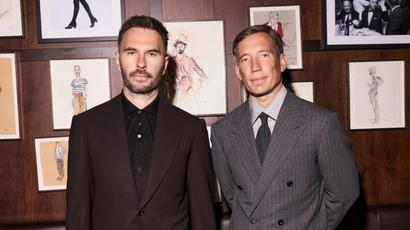
“The nicer the street, the more skeletons in the closet…” Jack Whitehall on suburbia, ceramics, and psychopaths.
From schoolyard myths to suburban scandal, Jack Whitehall remains a master of finding the absurd in the everyday, a comic sensibility shaped early, sharpened on stage, and now carried from stand-up circuits to Hollywood sets and beyond.
- Words by: Joseph Bullmore
- Photography: Stew Bryden
- Assistant: Jamie Appleby
- Video: Matthew Scales
- Styling: Tim Brooks
- Grooming: Claire Woods using Kosas and Larry king
- AD and Production: Freya Anderson
- Location: Jumeirah Carlton Tower
Jack Whitehall and I went to the same school, a fact I waited an admirable twenty-five seconds to bring up during our interview. But I’m glad I mentioned it, and not simply to reminisce about the formidable art teacher Gay Fanny Sturt, who the prefects said could shoot laser beams from her crutches and had once tutored a young Henry VIII. But also because Jack told me about a tour of the school he took as a boy before he joined, during what our lawyers may hope we describe now as “a different time”. Halfway through, Jack’s father, Michael, halted the teacher with a query. “Do they still do the Benson Steamroller here,” he wondered, in perfect innocence? This was the age-old (surely apocryphal) manoeuvre in which a vast history teacher named Mr Benson (I have changed his name, though not his heft) would subdue unruly children by lying them down in a row on the ground — before bulldozing over them like a tweedy cannonball.
“He asked this question in front of a load of other prospective parents, who were all absolutely aghast that the host had to somehow deal with this hospital pass — and pivot out of it into talking about how amazing the facilities were,” says Jack. Was his father suggesting that the Benson Steamroller was a pro or a con for his eldest son’s imminent education? “I’m not sure,” says Jack, slipping into Michael’s voice for a moment: “And if Mr Benson’s retired, do you have any teachers that can take over the honour?”

BRIONI blazer, £4,700, jumper, £1,120, trousers, £860, all available at brioni.com; CROCKETT & JONES belt, £160, shoes, £595, crockettandjones.com; IWC schaffhausen Pilot’s Watch Chronograph 41 TOP GUN Mojave Desert, £10,100, iwc.com

These are the sorts of things that happen to Jack Whitehall, as anyone who has watched his shows or his stand-up (or indeed, the offshoots now fronted by his father and his mother, Hilary), will recognise. The absurd and ridiculous seem to pop up even in the mundanity of the school tour; the Benson Steamroller idles ever in the wings. Only boring people get bored, they say, and perhaps funny things simply happen to funny people. Jack has made a singular and sparkling career out of this cosmic arrangement.
He started young, as you know — placing a foot on the capricious slip-n-slide of fame at about 17, and being wooshed away from there pretty much at once. After our prep school (the finest on the planet, I should say), Jack went to Marlborough, where his real passion was “art and sketches and drawing”, he says. Growing up, his house in Putney was “covered in paintings,” because Michael was an art collector. “So there’s 20th Century watercolours and landscapes and portraits, but also satirical cartoons and caricatures,” he says. Does he still paint now? “I feel like it’s something that maybe later on in life I might get back into,” he says. “Or maybe I could revive obscene cartoons. Me and my dad were in the Isle of Wight last summer on holiday and we found a smutty postcard museum. He was literally like a kid in a sweet shop. He bought all of them. He bought every single one of the postcards and annuals and a couple of originals,” Jack laughs. “So maybe that could be an avenue that I could go into.”

THOM SWEENEY jumper, £595, trousers, £695, both thomsweeney.com; CHURCH’s shoes, £890, church-footwear.com; Watch, jacks own

At school, Jack remembers launching a night-time ambush on the CCF platoon with balaclavas and water balloons (if only to expose the flaws in their security, of course), and producing an underground magazine filled with risqué cartoons about the teachers. He wasn't really cast in any of the mainstream dramatic productions, he says, and so he set up a sort of fringe sketch troupe (including Freddy Syborn, his later longtime writing partner) which soon headed up to the Edinburgh Festival. They weren’t particularly good, of course, but in the middle of each show Jack would kindly let his fellow stars rest while he performed a 15-minute stand-up routine.
“I definitely had a lot of confidence,” he says now. “A strength of will and determination that I was going to make it and get better. And I wanted everything to happen as quickly as possible. I remember that.” Any ego was swiftly “knocked down a little bit by the time I got up to Edinburgh,” he says. “We had some professional reviewers in who told me that I had a long way to go…”
That early stand-up won Jack the coveted ‘Amused Moose Laugh Off’ award in 2007, during which he deployed a sort of Estuary English growl and a world-weary grimace — largely to counter his plummy tones and youthful face, he thinks. “The people that really influenced me were the very sardonic, deadpan comedians,” he says. “People like Jack Dee, Stephen Wright, Stewart Lee. So for the first couple of years, I was sort of doing an impression of all of them. And it also felt a bit safer. You felt a bit insulated from going up on stage and telling jokes to strangers, because you were affecting the personality of someone who didn’t really care — and it’s much harder to die on stage if you’re really needy.”
Soon, Jack was named the new host of Big Brother’s Big Mouth, a show that now seems entirely of its moment. “There was a lot of hair,” Jack laughs. “It was New Rave — that sort of cocky, indie persona; very NME: a waistcoat and a t-shirt.” What does he remember of that time?
“I sort of accelerated through the ranks very quickly,” Jack says, “And ended up being a bit higher profile, and probably being on TV far sooner than I should have been. I think I probably would have been a better comedian by the time I landed on TV had I had an extra five or six years under my belt,” he says.
“But there was also just this novelty element — the fact that I was so young — that people latched on to. But I think that also some of my early television performances and some of the material that I was doing was maybe not being put under the scrutiny that it might have done had I been a little bit more experienced…”

PAUL SMITH jacket, £600, trousers, £400, both paulsmith.com; SUNSPEL T-shirt, £95, sunspel.com; PAIRS socks, £22, pairs-socks.com, IWC schaffhausen watch, £10,100, iwc.com

Jack’s father, Michael, was an agent — one of those roles that sees the good, the bad, and the ugly of the creative industries, usually in the space of a single lunch. How did he feel about his son stepping out into this capricious world? “He was always pretty supportive,” Jack says. “I mean, in the room, he was a terrible audience member and would never actually laugh — he would always caveat everything by saying that he was an ‘inward laugher.’ But it was always quite disconcerting when I’d do a gig and invite him along and everyone else is laughing — and he’s got that resting bitch face. And to be fair, that hasn’t changed to this day.”
There has been plenty of laughter, inward or otherwise, since. Jack’s career pinballed from strength to strength across his twenties — Fresh Meat; A League of Their Own; Bad Education; Travels With My Father; an excellent adaptation of Evelyn Waugh’s Decline and Fall. He has hosted the BRIT Awards six times, and got his Hollywood breakout in 2021 with Jungle Cruise, opposite The Rock and Emily Blunt. He has been a household name in this country for a decade-and-a-half now. What’s it like to have been so well known for such a large proportion of your life? Is it, well, nice, I ask?
“I don’t know whether it’s nice necessarily people knowing you. It’s nice to know that your work is appreciated, and the nature of people coming up to you and knowing you means that it’s permeated the culture to some extent. But then again, it is ultimately a double-edged sword. It very much depends on the context. It’s great if you’re trying to get a table in the restaurant. If you’re hung over at a soft play with your daughter, and you don’t want to have a chit chat with another dad at eight-am on a Sunday morning…”
On which note: Jack is now starring in The ‘Burbs, a new American show for Sky with Keke Palmer, which is set in an eerily perfect, oddly cinematic suburban street, onto which a new young couple move. Everything, of course, is not as it seems. It is a rich and familiar premise. A sort of revealing, fair-ground mirror of our everyday surroundings. Don’t we all suspect, in some way, that there are dark secrets lurking among our pretty streets?
“Oh, there always is,” says Jack. “Maybe it’s not murder, as is the case in The ‘Burbs. But there’s scandal on every street. And the nicer the street is, the more skeletons there are in people’s closets — and the more they’re trying to keep up appearances, to project something to the rest of the neighborhood,” he says. “I remember when I was growing up, in my pretty fancy suburb of Putney, there was so much scandal. We had one neighbor that ran off with another neighbor — they had this insane affair and then they had to leave. There was another one who was caught having some sort of sexual dalliance on Putney Common and the wife found out — and that was just two of our nearby neighbors…”
A similar theme — the darkness beneath the cheery surface — emerges in another recent project, Malice, released at the end of last year. Here Jack plays defiantly against type as a suave, psychopathic male nanny in charge of David Duchovny’s children on a sun-bleached Greek island. I ask him what it was like to go from jolly, chummy Jack to something altogether more sinister. “It was a really rewarding experience — but it was really hard work, and it was a real challenge, and it felt quite daunting. And also, when I was doing it, it was quite all-consuming. I felt so nervous every day when I set foot on set, and I needed time at the end of the day to decompress from it as well.” It has been described as ‘White Lotus meets The Talented Mr Ripley’. Why does he think this particular strand of eat-the-rich satire endures?
“I think there’s a delight people take in watching privileged people suffer on television,” he says. “That thing of watching these people with perfect lives — lives that may look better than ours — being put through the wringer, being ruined…”
“In the same way, do we really like seeing stuff about happy couples? We’d rather watch stuff about couples that are going through shit so that we can feel better about our own situation and lives,” he says. “In Love Island, I really enjoy watching the middle three weeks when they’re all in tears and betraying each other and having arguments and their love lives are a car crash,” he says. “And the minute they get loved-up and happy towards the end, it’s a very boring show. I don’t want to see smug, really good-looking people in happy relationships,” he laughs. Soon, he conceptualises a new Squid Game-esque element to the reality TV vehicle. “Let’s put that big lady in the Love Island garden. And every time one of them goes exclusive, her head spins round…”
I ask Jack what he thinks he’d be doing if he hadn’t done those first shows at Edinburgh; hadn’t had the guts and guile to start doing stand-up at such a young age. Does he ever think about that parallel universe? “I think I would have done everything I could within my power to just avoid having to do anything that felt too serious. I couldn’t do a desk job. I’m pretty dyslexic. And so I think I would have done everything I could to try and avoid having to work in an office or having to rely on my mathematical skills, say.”
Perhaps it would have been in the visual arts, I say. And so we end on a note for the admirable Mrs Fanny Sturt — the pottery teacher, archivist, and shared talisman of our prep school days. “She’s the connective tissue. She’s the Kevin Bacon of British prep schools. She’s the one who connects us all…”, Jack laughs. “So yes, maybe I could have done some smutty pottery instead,” he jokes. “Perhaps there’s a parallel career in ceramics for me there…”
“Hey — there’s still time.”
Jack Whitehall stars in The ‘Burbs, out now on Sky in the UK and Peacock in the US