Cars -- 3 days ago

Choosing running shoes is less about trend and more about biomechanics and comfort. The right pair supports your stride quietly, letting consistency do the rest.
Running shoes occupy a strange corner of the male psyche. Ask a perfectly rational man what he wants from a pair, and he will say something earnest about comfort and injury prevention. Release him into a shop, and he will gravitate, unerringly, towards whatever is brightest, sharpest and most likely to make him look like an unpaid brand ambassador for a small energy drink.
The modern running shoe wall does not help. It is a riot of foam, carbon, jargon and colours that do not appear in nature. Every box promises propulsion, energy return and personal bests. Very few talk about the unglamorous business of not wrecking your knees on a Tuesday.
Choosing properly is not complicated, but it does require a small act of grown-up honesty. You are buying shoes for the runs you actually do, with the body you actually have, on the surfaces you actually encounter. Everything else is mood lighting.
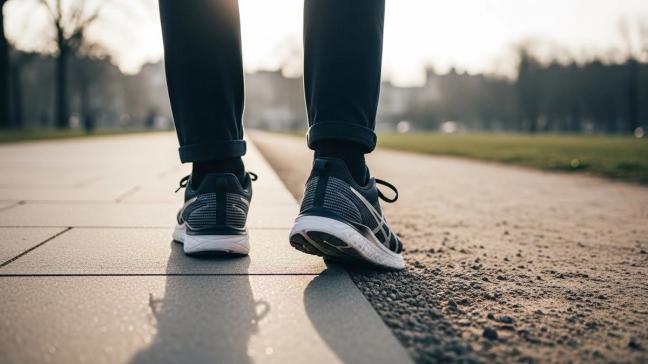
Before talking about gait, foam or any of the other things that turn runners into minor theologians, it is worth asking a stunningly simple question: where do you run?
If the answer is pavements, canal paths, parks and the occasional well-behaved gravel track, you are a road runner. You need a road shoe. That means a relatively smooth outsole with enough rubber to survive tarmac, a midsole that can cope with repetitive impact on hard surfaces, and an upper that does not disintegrate the first time it meets a kerb.
Shoes like the Nike Pegasus 41, ASICS Novablast 5 or HOKA Clifton 10 exist precisely for this life. They are built for the dull heroics of weekday mileage, not for leaping over alpine scree in an advertisement. They have cushioning that makes concrete feel slightly less personal, but not so much lug that you sound like you are wearing climbing hardware.
If, on the other hand, you spend most of your time on actual trails, mud, roots, rocks, and slopes, then you need a trail shoe and the honesty to admit it. That means deeper lugs for grip, tougher uppers and usually some kind of rock protection underfoot. Take a pure road shoe into proper off-road terrain, and you will learn interesting things about traction. Take a trail shoe onto tarmac for long distances, and you will discover why people talk about feeling “beat up”.
There are hybrids that promise door-to-trail competence, and some of them even deliver, but the principle is clear. Choose for the majority of your miles, not for the odd romantic weekend away.
The running industry loves the language of gait analysis and pronation. It is an intoxicating mix of science and flattery: you are filmed on a treadmill, someone frowns at your ankles in slow motion, and at the end of it, you are told you have either neutral gait, overpronation or the very rare distinction of supination. It feels clinical. It is, in truth, often just structured common sense.
If your ankles collapse inwards dramatically when you run, or your old shoes are worn down almost to the midsole on the inside edge, you probably benefit from some kind of stability shoe. These are models that build subtle structure into the midsole to stop your foot rolling in quite so enthusiastically. ASICS Gel Kayano 32, Brooks Adrenaline GTS 24 or New Balance 860 are examples of the genre: they do not straighten you up like a brace, they simply stop your biomechanics from behaving like a policy experiment.
If your wear pattern is fairly even and you do not have a history of niggles linked to overpronation, a neutral shoe is usually fine. Think Novablast, Pegasus, Ghost, 1080, Cloudmonster and similar names that populate “best daily trainers” lists with numbing regularity.
The important thing is not to treat support as a moral issue. Stability shoes do not mean you are defective. Neutral shoes do not mean you are superior. They are merely tools. If your joints, tendons and shins are happier with a bit of guidance, take the hint.
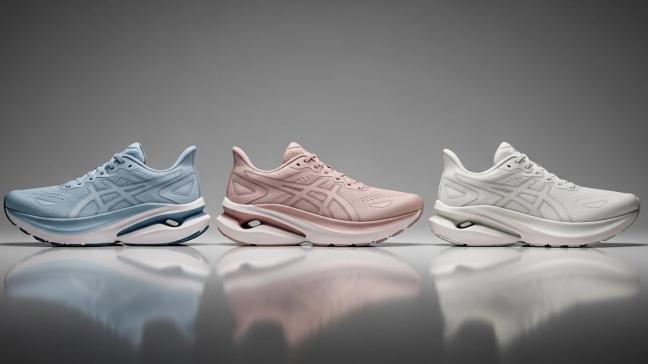
Modern marketing has turned midsole foam into a kind of soft arms race. There are shoes so thick now that they resemble small platforms. The vocabulary can quickly become tiresome, but three ideas matter.
Cushioning is simply how soft or firm the shoe feels underfoot. Max cushioned models like the HOKA Clifton 10, New Balance 1080 or Brooks Glycerin aim to make long, easy miles feel like you are landing on a politely supportive marshmallow. They are kind to joints, slightly less kind to your sense of ground contact, and excellent if you mostly do steady runs on hard surfaces.
Stack height is how much material sits between your foot and the floor. High stack generally means more cushioning and more distance from impact, but it can also mean a slightly more precarious feeling if you are prone to wobbling. Lower stack shoes feel sharper and more connected, but your legs will know about it if you go far.
Heel-to-toe drop is the difference in height between the heel and the forefoot. Traditional trainers live in the 8 to 12 millimetre range. Many modern shoes hover around six. “Natural” offerings go lower. Higher drops tend to favour heel strikers and can be kinder to tight calves and Achilles. Lower drops encourage more midfoot landing but punish anyone whose lower legs are not ready for the extra load.
The temptation is to chase whatever is fashionable. Carbon-plated race shoes with enormous stacks and responsive, exotic foam are very clever pieces of engineering if you are running a marathon at a pace. They are less clever for pottering around the park twice a week. For most people, a moderately cushioned shoe with a sensible stack and a drop close to what they are used to will always feel better than the latest experiment in physics.
No amount of technology will rescue a bad fit. This sounds obvious, yet many men will tolerate remarkable discomfort in the name of aesthetics. They will buy shoes that are slightly too small because they “look sleeker”, then act surprised when their toenails attempt to grow.
The rules are unglamorous but reliable. There should be roughly a thumb’s width between your longest toe and the end of the shoe when you are standing. Your heel should feel secure without being gripped like a misbehaving junior minister. The midfoot should be snug but not strangled. Your toes should have room to spread and move.
Try them on at the end of the day or after a run, when your feet are marginally swollen and more honest. Wear the socks you actually use for running. Walk around. Jog a few steps if the shop allows it. Any hot spot, pressure point or rubbing you notice in two minutes will become a small catastrophe at six miles.
This is not vanity sizing. Go up half a size from your normal dress shoe if necessary. It is easier to live with a number on a box than with blackened toenails and creative blisters.
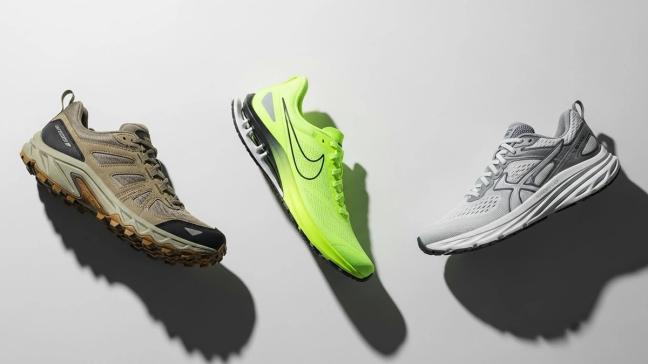
One of the quieter truths about running is that no single shoe can do everything perfectly. The industry has simply monetised this by suggesting you own several. You do not need a full rotation to start with, but it helps to understand what each category is for.
A daily trainer is your workhorse. It is the Pegasus 41, the Novablast 5, the Brooks Ghost 16, the 1080 v14, the shoe you reach for most days for easy and steady runs. It prioritises comfort, durability and forgiveness over drama.
A tempo or speed shoe is lighter, a little firmer and often slightly more aggressive in its geometry. Think Nike Zoom Fly 6, New Balance Rebel v5, Saucony Endorphin Speed. You wear it when you are doing intervals, faster sessions or simply want to feel a bit more race-ready. It is not designed to soak up every plodding mile.
A race shoe is very light, very responsive and often uses a carbon plate and expensive foam to push you forward. Saucony Endorphin Pro, adidas Adios Pro, New Balance SC Elite live here. They can feel unstable at slow speeds and are usually overkill unless you are chasing times over longer distances.
If you are a normal human being rather than a spreadsheet with legs, you can safely start with one good daily trainer and ignore the rest of the menu until you find yourself running often enough to justify tinkering.
The specific models change every year, but certain families have become dependable signposts. If you are neutral and want a forgiving daily trainer, shoes like the Nike Pegasus, ASICS Novablast, HOKA Clifton, Brooks Ghost, New Balance 1080 or On Cloudmonster all sit broadly in that space. They differ in personality. The Novablast is bouncier, the Clifton softer, the Ghost more traditional, but all of them are built to make routine mileage less unpleasant.
If you need stability, ASICS Gel Kayano 32, Brooks Adrenaline GTS 24, New Balance 860 or HOKA Arahi 7 offer varying flavours of support without feeling like orthopaedic devices. They use rails, denser foams and clever sidewalls to nudge you into line rather than bark orders at your ankles.
If you have started experimenting with faster work, shoes like the Zoom Fly, Rebel, or adidas Adizero Evo SL come into play, providing a little more snap and less bulk. Race shoes with carbon plates sit one notch further up the seriousness scale. They are wonderful tools when deployed correctly and a mildly absurd affectation when worn for a shuffle round the block.
The point is not to memorise model numbers. It is to recognise that you are not buying in a vacuum. Entire categories of shoes exist to solve the exact problem you have. Your task is to match your needs to the right family, not to discover some secret unicorn.

Running shoes are not heirlooms. They age in a way that is visible to anyone who looks and audible to any joint that is forced to keep using them. Most will give you somewhere between 300 and 500 miles of civilised service. After that, midsole foam compresses permanently, tread wears down, and the structure that once kept your foot aligned starts to wobble.
If a shoe that used to feel fine suddenly leaves you mysteriously sore, look at it. Are the creases deep and severe?. Is the outsole bald in places? Has the midsole lost its bounce? Have you, if you are honest, been wearing them for far longer than you can quite remember?
Retiring a pair is mildly melancholy, but clinging on leads only to physiotherapy. Keep them for gardening, travelling or errands by all means, but let something younger handle your long runs.
In the end, choosing running shoes is not an exam in biomechanics. It is an exercise in appropriate realism. A good choice is not the loudest colourway, the highest stack or the most ferocious marketing copy. It is the shoe that disappears once you start moving.
If, ten minutes into a run, you are no longer thinking about the shoe at all, if your feet feel unremarkable and your joints are silent, if the only thing you notice is your breathing and the weather, you have chosen well.
That is the unglamorous, quietly luxurious standard. Not spectacle, not drama, just equipment that lets you get on with the mildly ridiculous, entirely admirable business of running, without complaint from the ground up.
To receive the latest in style, watches, cars and luxury news, plus receive great offers from the world’s greatest brands every Friday.