Nick Jones on life after Soho House and a fresh start at St Clement
After stepping back from his Soho House empire following a prostate cancer diagnosis, Nick Jones decided to take a break. But not for long. Now, he’s opening the ambitious St Clement hotel on the Thames – and going back to his hospitality roots
- Words by: Joseph Bullmore
Just before my interview with Nick Jones began, in the about-to-be-opened River Loft suites on an empty floor at the handsome new St Clement hotel, a fire alarm rang out. “Attention please, attention please,” it said – an automatic test alert, conveyed by the sort of reassuring, disembodied voice usually reserved for Tube platforms or Radio 4 announcers or God. But it was hard not to read the message, as the voice bounced off the brushed steel kitchen counters and across the crisp white linen of the sofa, as some sort of subliminal portent for the wider buzz around the hotel – and perhaps around this new chapter for Jones himself. The hospitality guru is the hospitality guru. His success with Soho House – creating and expanding an international private members’ club, which had previously been thought a contradiction in terms – existed on an almost cultural level. How many homes, bars, pubs, coffee shops, airport lounges and film sets were influenced by the club’s unmistakable, mid-century industrial, precise-yet-baggy aesthetic? How many hospitality venues have tried, subconsciously perhaps, to meet its particular mood at its best: that mix of relaxation and excitement; of informality and occasion? And so when Jones stepped away from the business in 2022, just after its IPO, plenty of people (and lifestyle journalists) speculated on his next move. Might he start a new members’ club? Write a book? Buy a farm? Host – horror of horrors – a podcast?
The answer now lies in a gleaming new building that hovers somewhere between The Strand and the River Thames. This is St Clement, named for the parish of the dove-grey church situated a few hundred yards away, and already something of a pilgrimage site itself. It houses Café Clement beneath a crimson awning (“Really rather good,” according to Grace Dent) and shelters Tuccis and Mescals and people who pretend not to notice them. (Danny Bohar is in charge, and the cheese soufflé is superb.) Soon, there will be a rooftop restaurant helmed by Florence Night called Lunette, and later on an impressive health club element, and at some point a screening room, and Alex Eagle will open a highly tasteful store here, too.
But that will be it. What, no Malibu outpost? No Berlin annexe? No country house escape? Jones says he has deliberately kept St Clement to one spot – a single building, albeit one that’s pretty massive and already alive with different moods in its different corners. He was diagnosed with prostate cancer in 2022, caught it at a manageable stage, and fortunately got through it; though he winces now as he remembers the agonising wait for the prognosis, and the day on which he kept missing his doctor’s calls to hear it. He was given the all-clear and decided that any project he pursued next should have a more human, reasonable, local scale – and so when the opportunity came up to work with landlord and previous collaborator Mark Wadhwa on this spot, he felt it perfectly matched his new expectations.
“At that point, I decided I wanted a different life,” he told The Times recently. “More balance. I didn’t want to be knackered and napping each weekend.”
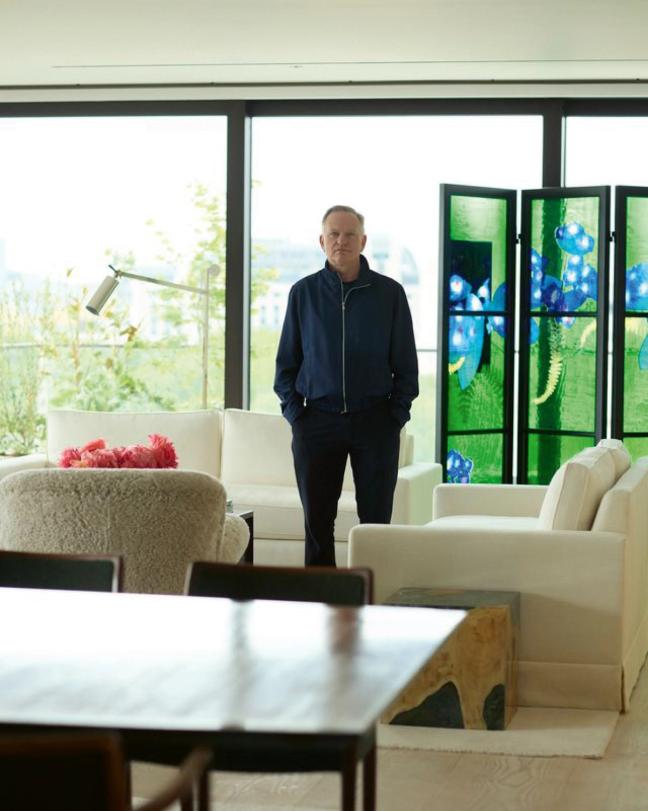
I picture him soon, as the hotel doors open for the first time, slightly like Ralph Fiennes’s character in The Grand Budapest Hotel – a charming, fastidious figure who knows every inch of the place and all of its clients – though I suspect he might not relish the pink uniform. As it is, he is dressed in a soft grey t-shirt and relaxed navy blue trousers, and seems completely calm amid the dress-rehearsal frisson of the wider hotel. He sits down on the immaculate acreage of that soft white linen sofa, and imagines that this suite will soon host some decent parties for the forthcoming London Fashion Week. “I bet it will see a few red wine stains,” I say with a shudder.
“Oh, I hope so!” he says. If there is one thing that Nick Jones knows, it is that rooms, like careers and lives, are meant to be lived in.
JB: How do you feel as you look around you at this beautiful room? There’s still a scent of fresh paint in the air. It all feels very new…
NJ: Obviously nervous. Even though I’ve been opening places for quite a long time, I think you need to be nervous because it keeps you on your toes. So far, I’ve been really happy with everyone’s reaction. We’re not open yet, but people have been trying rooms out. And we got a Café Clement open downstairs and Bobby’s Bar open downstairs. So it’s feeling good, Joe. But you never know.
JB: Has there ever been an opening where you’ve been 100 per cent sure that it would work?
NJ: Never. Not once. Lots of things go spectacularly wrong at the opening. A roof might not be on or there might be no electricity or there might be no water. But you get through it.
JB: What was the first spark for doing this? Why did you want to dive back into hospitality after leaving Soho House?
NJ: It’s a question I ask myself often. I stepped down from Soho House because I had prostate cancer. And even though I was very lucky – I caught my prostate cancer early, and I’m cancer free now – I sort of reflected on things after that horrible phone call, the one where they tell you if it hasn’t spread or it has spread. It was a sort of 50-50 moment. If it had spread, I would’ve only had three or four years left to live. If it hadn’t spread, like it hasn’t for me, I had the whole of my life – but I wanted to live my life differently. I didn’t want to be on an airplane all the time opening Soho Houses globally. Because I’ve been doing that for 30 years. When I stepped back, Mark Wadhwa, who I’ve worked with a lot, and who was building a hotel here, said, “Well, how about it?” And I thought, yeah, it’d be quite nice because it’s just one project. It’s not like I have to get on an airplane. I can get back into the weeds and get back to selecting the team. I can be very involved in every single detail, and that appealed to me. And I think that’s why I’m really enjoying it. I got into hospitality because I love a room full of people having a good time. And I’m back doing that.
JB: So it takes you back to those earliest days of Café Boheme and Soho House, in the early 90s. How has hospitality in London changed, do you think, in that period?
NJ: Fundamentally, it hasn’t changed. It still involves a plate of food and a drink. But people do it differently now. People might not drink so much, people might not eat so much, people might not want to go to bed so late. So it might be more expensive to run a restaurant – the rent, the rates, the staffing. It’s always slightly changing, and never quite in the right direction. Everything gets more expensive, and you don’t always want to pass it on to the customer. The customer is the brightest person – they spot everything. I have huge respect for the customer. But yeah, London is the greatest city in the world – let’s face it. And I’ve been to a few.
JB: Your first-ever restaurant was called Over the Top…
NJ: It was indeed. Thank you for reminding me. It was back in 1988. I’m sure most people reading this weren’t even thought of then. It was on Fulham Broadway, an area in London I still can’t drive past now because of the failure I had with Over the Top. The idea was that you chose a bit of steak, a bit of a burger, a bit of chicken, a bit of lamb – and over the top of it, you put sauce. We had a variety of different sauces, which were all disgusting. They were named after mountains because you were going “over the top”. I mean, it gets worse and worse! Can we talk about something else? It just wasn’t very good, but I learned so much. That’s where I learned the customer is so sensible. They don’t want complications, they want simplicity and they want it to be consistent.
JB: What was your first job in hospitality?
NJ: At our local rugby side at home. I used to work behind the bar at the age of 13. And I really enjoyed it. I would also prepare the players’ teas, and I thought: “I quite like this.”
JB: And you’ve worked at almost every rung of the hospitality ladder since then. You were in marketing at one point; you were a barman, I think, in Mayfair. You did housekeeping at the Westbury Hotel…
NJ: I think you can’t run a place unless you know every job. I worked in the kitchens. I worked in housekeeping. I worked in all the departments when I was training, when I was getting my apprenticeship.
JB: Soho House came up incredibly organically. You’d never really spent time in a members’ club before you started it…
NJ: We opened Soho House because there was a site above Café Boheme. It was offered to me and they said: “Will you take this space?” I thought, “Well, what can I do? It’s got a small door, so it’s going to be a private members’ club.” So that’s how I started. There was never any plan. We never had a grand business plan. Half the problem is I’m very dyslexic and find it difficult to write, so I kept away from that.
JB: I’ve heard you say before how that can be a useful trait in a way. It means you simplify things. You’re not overly verbose or complex.
NJ: Whatever you may have can be an advantage. Being dyslexic is an advantage because you look at things differently. I’ve always tried to simplify things. And well, why can’t we just put that on one sheet of paper with bullet points and just make it a bit simpler? Why does it have to be five pages longhand, which no one’s ever going to read?
JB: Soho House was set up as a gathering spot for creative people in London. You must have met a lot of them in your time. The narrative we have now is that 30 years on, it’s a really tough time to be a young creative person in this city, because it’s so expensive to live here, for one thing. And industries are in flux and everything’s changing. What do you think about the state of creativity in London?
NJ: I think it is tough. The world is in a tough place at the moment. And Britain is in a tough place at the moment. It’s difficult for young people to get work. Things are changing all the time with AI. I think it is very, very challenging for young people. I think the risk is that tightening up on employment laws sometimes works against what you’re trying to do. Because as someone who employs lots of people, you’re always going to look after your staff. That’s a given. You’re not going to mess around with their rotas or whatever.
But we are in a tricky time and margins on restaurants are much more difficult than they were. Finding good quality people who want to work in hospitality is difficult. And then on top of that, the general audience who come to your restaurants are more careful with their money. But it will change.
JB: You seem to be an optimist.
NJ: I am an optimist. Maybe that’s not the best thing. But I do come back to us being the greatest city in the world. And there have been politicians who’ve messed it up a bit and brought in policies which aren’t right and don’t help London. Those policies will be changed. They might not be changed now, but in 10 years’ time, they’ll be changed.
JB: When young people come to you for advice these days, what kind of questions are they asking?
NJ: Well, when people come and ask me, I’m always encouraging of entrepreneurship. So I always want people to go and do something on their own if they can. So I’m very, very encouraging to people trying to get their idea off the ground. But it’s just difficult at the moment. It’s more difficult than it has been in a long time.
JB: We had Martin Kuczmarski, your friend and former COO, on our podcast before, who said that one of his abiding memories of the latter stage of Soho House was of planes and hotels and relentless travel…
NJ: I had dinner with Martin last night. And yeah, he was on a plane a lot. That was a bad time!
JB: What do you think of that period, looking back on it now? Does it seem a mad time? Or was it necessary?
NJ: Was it necessary? That’s a good question. Was it a mad time? Yes, it was a mad time. But we were trying to build a global membership club. And we are the only ones who’ve done it – though some people might have a secondary club in another city. But it’s hard work getting around all the sites…
“Was it necessary? That’s a good question. Was it a mad time? Yes. But we were trying to build a global membership club. And we are the only ones who’ve done it”
JB: Do you have a strong work ethic?
NJ: Oh, I’m a workaholic. Which sounds great. But actually, it’s not. It’s like being an alcoholic. Since stopping at Soho House, I’ve really tried to work on that: to let it go at times and not have to be obsessed about work all the time. Work isn’t everything. Work’s a nice part of your life. And if it’s fun and enjoyable, that’s a really good thing, but it’s not a 24-hour thing.
JB: A big part of that adjustment in your attitude, was, as you say, your prostate cancer diagnosis. What is it like to sit and wait for a call like that?
NJ: I sympathise with every single person who’s had to wait for that news. It’s horrible. Millions of people have to go through it. It’s a horrible thing. And I remember when he was phoning me, I kept missing his call. I missed his call because I was in a meeting or I was doing this or that. And then I couldn’t phone him back because he would phone on one of these undisclosed numbers. It started in the afternoon and he eventually got hold of me at eight o’clock in the evening. I wouldn’t want anyone to go through that…
JB: Are you a gregarious person? I’ve heard you say before that you were shy growing up, which surprised me.
NJ: Yeah, I was shy. I’m still a bit shy now. But you work against shyness, don’t you? You have to take a bold step.
JB: Is there a recipe to create atmosphere in a room or a space?
NJ: I don’t think you can go to a book and find a recipe for it. I think people want to be in a comfortable atmosphere. They want to be in a warm atmosphere. They want the lights to dim nicely. They want good music. They don’t want anything too pretentious, I think. So that’s what I’ve always honed our interiors around. I spent a lot of time and effort on the acoustics downstairs. I think a customer doesn’t want to see the computer system that you use to ring the food through, either. I don’t think a customer wants to see process or procedure. They want to see passion and a brilliant product. We’re working hard on getting rid of a lot of kerfuffle.
JB: You oversaw an aesthetic that didn’t just get copied in hospitality, but I think has seeped down into people’s houses and the wider culture. The Soho House look is sort of the aesthetic of our age, in many ways.
NJ: Yeah, I realise that. I didn’t realise that at the time, but I do realise that now. It was organic, though. None of it was intentional.
JB: You must just have some very particular or precise tastes, or are very good at making decisions…
NJ: I love making a decision. I never push anything down the road. I’ll make a quick decision. Even if it’s a quick wrong decision. Rather that, than a long, drawn-out, thoughtful, correct decision.
JB: The people, of course, are very important in a place like this, whether it’s new or whether it’s 20, 30, 50 years old. How does one curate a crowd and a scene?
NJ: You invite the people you know and you like, and you say no to other people, and a place quickly creates an identity of one thing or another.
JB: I’ve heard you speak before about the importance of being bored – something which maybe you’ve rediscovered more recently.
NJ: I like getting bored. I don’t mind that at all. When I was at home [after leaving Soho House] – and my home’s lovely and it’s beautiful and all of that – I got a bit bored. But then I thought to myself: “God, I think this is quite fun. I must build in boredom. It must be useful, somehow.”
JB: So September 16th is D-Day…
NJ: It’s Fashion Week, so we’ve got to be open and we’re full.

JB: That’s a baptism of fire, then. You’ve got the fashion crowd descending on the club. Do you think these sofas will see some red wine, or some late-night dancing on them, maybe?
NJ: I hope so! Yes. I hope for all of that.