Car of the week: the Range Rover goes electric
The original luxury SUV has gone electric, and it might just be better than ever.
- Words by: Rory FH Smith
I’m perched on a muddy bank above Loch Ness in a downpour, mid hot stone massage and enjoying the silence. There are few cars in which I’d feel so relaxed in at this point, but shrugging off perilous situations is a Range Rover’s sweet spot. For more than 50 years, the Range Rover nameplate has stood for comfort and off-road confidence in equal measure but now it’s time for this automotive icon to plug in and embrace electrification.

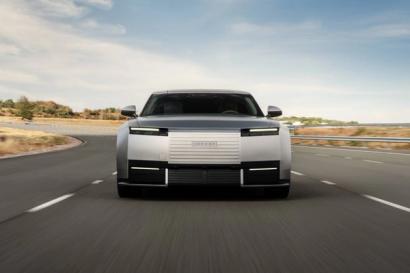
Bar a tweaked grille and small EV badges on the wheels, it looks exactly like its petrol and diesel siblings.
From the outside, you’d need a keen eye to tell it apart from any of the current Range Rovers on offer. Bar an aerodynamically tweaked grille and small EV badges on the wheels, it looks exactly like its petrol and diesel siblings. But that was the point, according to the team behind it. When development began, customers had one request, says Range Rover’s managing director, Martin Limpert: “Make it a Range Rover first and an electric second.”

The battery-powered Range Rover is just as competent off-road, with a 900mm wading depth.
That is no small ask of a car with so much in its history. The original, unveiled in 1970, had two doors, vinyl seats and an interior you could wash out with a hose, yet a year later it became the first vehicle exhibited at the Louvre, hailed as “an exemplary work of industrial design”. It went on to cross the roadless Darién Gap and win the first Paris-Dakar rally. Luxury crept in with the four door model in 1981 and the model has continued to climb up the luxury ladder ever since. Electronic air suspension arrived in 1992 and an all-aluminium body in 2012.

It’s spectacularly smooth on and off road, with new levels of silence on the move.
But going electric is the biggest change yet. It took a decade to make it, so expectations are high but for now, my expectations are rather more limited: getting off this Scottish Munro in one piece. Thankfully, the battery-powered Range Rover is as competent off-road as its combustion-engined siblings. Given its electric underpinnings, it’s capable of controlling the slip on all four wheels much faster than the fossil-fuel models, tweaking each wheel within 50 milliseconds. That makes a difference on a slippery slope but also on the road, where the Range Rover feels firmly planted, helped in part by its battery sitting low in the body, bringing down the car’s centre of gravity.

Inside, the ‘S’ on the drive selector now stands for Single Pedal, not Sport.
It's spectacularly smooth on and off-road, offering new levels of silence on the move thanks to the absence of any engine noise or rumble. The 542bhp is enough for the electric Range Rover to hit 62 mph in 4.5 seconds. The team have resisted the temptation to make this into a neck-snappingly fast EV and deployed the power in a more mature way, focusing instead on how the car responds under acceleration, cornering and braking.

Rather than pitching skywards or lurching forwards, the Range Rover remains composed on the road.
Rather than pitching skywards, rolling from side to side or lurching forwards under braking, the Range Rover remains composed thanks to its software and air suspension. There’s still a hint of roll and pitch but only enough to make the ride still feel natural. “A Range Rover has to breathe down the road. We haven’t changed that,” says Matt Becker, JLR’s vehicle engineering director.

It’s business as usual on the inside, with the familiar Range Rover interior layout unchanged.
On the inside, it’s unchanged save for the ‘s’ drive selector now standing for single pedal driving, rather than sport mode. Despite one pedal driving being around for more than a decade, the Range Rover’s is beautifully calibrated, which lends itself to everyday driving and, hopefully an increased range as a result, with the car using the braking energy to regenerate electricity to top up the battery. On the subject of range, Jaguar Land Rover claim a real-world range of 333 miles but expect something towards the top end of 200 just to be safe.

Prices start at £154,070 and can rise to north of £200,000 for the flagship SV models.
Prices start at £154,070 and can rise to north of £200,000 for the flagship SV models, which puts the Range Rover firmly into Bentley Bentayga territory. For that money, you get the most refined Range Rover yet and one of the most complete EVs currently on sale. Combustion loyalists can still order a V8 but after a day in the electric car, I suspect significantly fewer of them will.
Range Rover Electric: the details
- Powertrain
- Two permanent magnet electric motors, 118.5kWh battery
- Power
- 542bhp
- Range
- Up to 372 miles
- Battery
- 118kWh
- Charging
- 10-80% in around 22 minutes (350kW)
- Torque
- 627lb ft
- Weight
- 2.8 tonnes
- Price
- From £154,070
Range Rover