
Food & Drink -- 5 days ago

That soft green glow is doing more work than it appears. It is chosen not for aesthetics, but for accuracy, reliability and how the body absorbs light at rest and in motion.
At some point, usually in a dark bedroom when you roll your wrist over to check the time, your smartwatch decides to stage a small science fiction experiment. The back of the case flickers to life, bathing your skin in an eerie green glow, as if your ulna had booked a VIP table at a nightclub.
It looks faintly alarming, mildly radioactive, and, once you notice it, impossible to ignore. So why do smartwatches use green light, and not blue, red or something less reminiscent of a lightsaber?
The answer is half biology, half engineering, with a dash of battery anxiety.
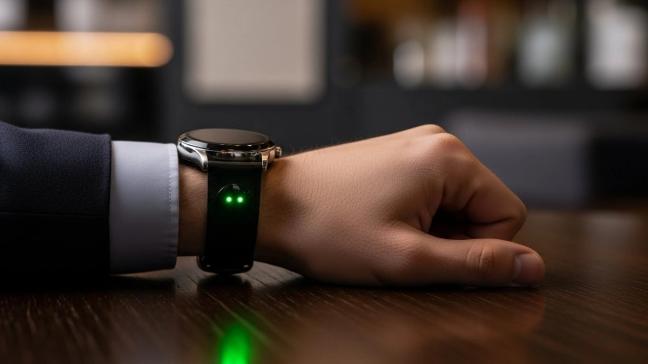
The flashing lights on the back of a smartwatch are not decorative. They are the working face of an optical heart sensor, a small laboratory tasked with keeping track of your pulse and, increasingly, your cardiovascular health.
Modern watches measure heart rate using a technique with a name only a researcher could love: photoplethysmography. Fortunately, the principle is straightforward. The watch shines light into your skin, then measures how much of that light bounces back. As your heart beats, blood volume in the microscopic vessels under the sensor rises and falls. Blood absorbs some of the light, so the amount that comes back to the photodiodes changes with each heartbeat. Turn that pattern into a waveform, and you have your pulse.
You can think of it as an extremely polite torch and mirror routine. The LEDs provide the torch. The blood vessels are the mirror that keeps changing shape in time with your heart. The photodiodes listen to the difference between “more light” and “less light” and translate it into beats per minute.
So far, so elegant. The interesting part is why so many of those torches are green rather than any other colour on the shelf.
Blood is red for a reason. Haemoglobin, the protein that carries oxygen, absorbs certain wavelengths of light and reflects others. Red light is reflected more, which is why blood and, distressingly, open wounds look the way they do. Green light, however, is absorbed far more enthusiastically. Smartwatch designers take full advantage of this quirk.
Shine green light into well-perfused skin, and haemoglobin behaves like an over-keen guest at a free bar. It soaks up the photons with gusto. Between beats, when there is slightly less blood in those tiny vessels, more light comes back. During a beat, when the arteries and capillaries swell with fresh blood, less light returns because more of it has been swallowed. That swing between high reflection and low reflection is what gives the watch a clear, obvious pulse signal.
Depth matters too. Green light does not penetrate tissue very deeply compared with red or infrared light. Instead, it interacts mainly with capillaries close to the surface. For a wrist-worn device, that is not a limitation; it is an advantage. The watch wants information about the superficial vessels, not the deeper plumbing, because those surface beds give a crisp, high contrast snapshot of each heartbeat. Studies comparing different wavelengths repeatedly find that reflective green light at the skin surface provides an excellent signal for pulse rate monitoring in this configuration.
Then there is the small matter of movement. The wrist is not a calm place. You swing it while walking, twist it while lifting, and slam it into things by accident. All of this introduces noise into the optical signal. Green light, in the reflective arrangement used by consumer wearables, tends to be slightly more resilient to this chaos than single wavelength red or infrared on their own, which is why most mainstream devices lean on it for day-to-day heart rate, particularly during workouts.
And behind the biology, you find something even more persuasive to engineers: green LEDs are cheap, mature and efficient. They can be driven at relatively low power while still producing a strong enough signal for the sensor to read, which keeps the module compact and battery life within the bounds of sanity.
So green does three jobs at once. It gives a big, dramatic pulse signal, interacts nicely with the bits of your circulation that the watch can actually see, and does so without flattening the battery by lunchtime.
If you look closely at the back of a high-end smartwatch, you may spot other LEDs lurking alongside the green ones. Usually red. Sometimes, a deeper, almost invisible infrared. The watch is not getting festive. It is switching techniques.
Green is excellent for heart rate at the surface. For blood oxygen measurements, the famous SpO₂ reading that promises to tell you how happily your haemoglobin is holding onto oxygen, the problem changes. Oxygenated and deoxygenated haemoglobin absorb red and infrared light differently, especially a little deeper in the tissue. Devices exploit this by shining two wavelengths into the skin and comparing how much of each comes back. The ratio lets them estimate oxygen saturation in a way that roughly mimics the traditional fingertip pulse oximeter.
Infrared has another quiet advantage. It is less conspicuous. Watches can use infrared LEDs for low power, background heart rate checks and other passive monitoring without lighting up your wrist like a small nightclub every few minutes. Apple, for example, uses green LEDs for active, high-accuracy readings when you ask for them or start a workout, and infrared for more discreet periodic checks in the background.
Researchers are increasingly enthusiastic about mixing and matching all three colours. Multi-wavelength photoplethysmography trunk of a phrase, essentially means that the watch shines green, red and infrared, then lets algorithms disentangle a richer set of information about blood flow, arterial stiffness and other cardiovascular metrics that make doctors very excited and most normal people slightly tired.
For all its charms, green light is not flawless, and the industry has finally begun to admit it out loud.
Skin is not optically neutral. Melanin, the pigment responsible for skin tone, also absorbs light, and that absorption is particularly noticeable in the green part of the spectrum. In practice, that means a watch shining green LEDs into darker skin may see a weaker, noisier signal than it would through lighter skin, because more of the light is swallowed before it ever reaches the blood vessels, and more of the returning light is lost on the way back.
Several studies and reviews in the last few years have highlighted that heart rate accuracy from wrist-worn PPG can be lower on darker skin tones, especially during vigorous movement. The problem is not that the technology collapses entirely; it is that the error bars widen. Readings can lag or drift, workouts can show slightly implausible peaks or troughs, and the device’s confidence in its own measurements quietly shrinks.
The response from the serious end of the market has been twofold. First, more colours. Combining green with red and infrared helps compensate for the way different wavelengths interact with melanin and blood. Second, better software. Newer algorithms attempt to account for skin tone, movement and perfusion differences explicitly, filtering out more noise and relying on history and context to decide which datapoints to trust. It is not magic, and it is not perfect, but it is at least an acknowledgement that “one LED fits all” was never going to be the end of the story.
If you have darker skin and notice that your watch sometimes disagrees with a chest strap during sprints, you are not imagining it. The industry is, slowly, trying to catch up.
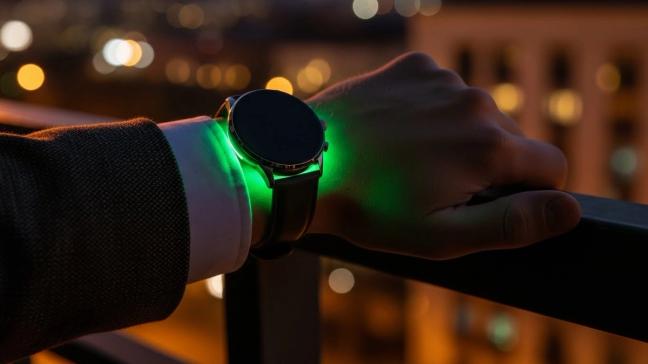
From a user’s perspective, the green light on the back of a smartwatch is simply the optical equivalent of a stethoscope. It is how the device keeps track of your heart without resorting to wires and electrodes. The fact that it looks like a nightclub for ants is incidental.
When you start a workout and feel the watch grow slightly warmer against your skin, those green LEDs are pulsing rapidly to capture as much data as possible. During a day at your desk, they may fire in short, occasional bursts to keep your resting heart rate and background trends up to date. At night, depending on settings, they may spend several hours sampling gently to estimate sleep stages, while red or infrared chips are used to check oxygen saturation.
All of this works whether or not your phone is nearby. The phone helps with bigger jobs such as GPS routes, syncing graphs, pushing notifications, and uploading data to apps, but the sensor itself does not need it. Most watches can keep measuring, storing, and showing your heart rate on the spot, like a little self-contained lab strapped to your wrist. Only later, when you wander back into Bluetooth range or connect to Wi-Fi, does everything get filed neatly into the long-term record.
If you find the glow irritating in the dark, most watches allow you to limit continuous measurement or disable certain features, at the cost of less frequent data. If you notice marks on the skin under the sensor, that usually means the strap is too tight, or the LEDs are spending too long trying to get a signal through a less-than-ideal fit. The technology is clever, but it still obeys the old rule of tailoring: snug, not strangled.
The important point is that the green light is not cosmetic. It is the visible tip of an entire optical system designed to estimate what your heart is doing from moment to moment. Its colour is a decision informed by haemoglobin’s bad habits, tissue optics, motion artefacts and battery chemistry, not the taste of a bored designer.
You are, in effect, wearing a tiny research project. One that happens to tell the time, pay for coffee and nag you about standing up occasionally. The green flicker is just the moment when the science behind all of that briefly makes itself known.
To receive the latest in style, watches, cars and luxury news, plus receive great offers from the world’s greatest brands every Friday.