
Style -- 5 days ago

A luxury bed is built to be lived with for years, not replaced on a whim. Its cost reflects time, craftsmanship and an insistence on getting the fundamentals right rather than merely adequate.
At some point in adulthood, roughly when your back starts submitting formal complaints, you discover the terrifying truth. A proper bed costs about as much as a small car. Not the sheets. Not the frame. Just the thing in the middle that you have been flinging yourself on without much thought since university.
You wander into a bed showroom in good faith and emerge dazed, clutching a quote for a mattress that appears to contain wool from blessed sheep, springs forged by sorcerers and a lead time that suggests it is being built in a very slow country. The natural question is: why?
How did lying down become a capital project?
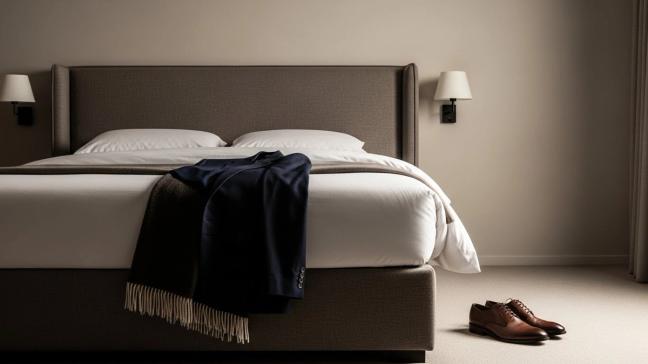
The first reason luxury beds are expensive is brutally simple. They are full of expensive things.
Ordinary mattresses rely on low-grade foam and synthetic padding that behaves a bit like pressed sandwich filling. Comfortable for a while, then oddly flat. Luxury versions start rummaging around in nature. Long staple cotton, breathable linen, silk, lambswool, alpaca, cashmere, coconut fibre, horsehair, and even the occasional Scandinavian seaweed. These are not the sort of materials you find in discount duvets.
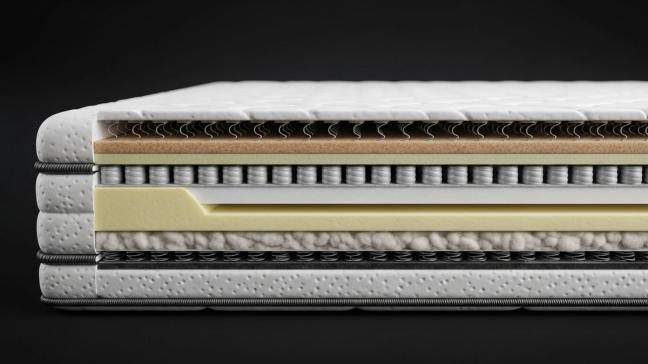
All of them cost more per kilo than polyester wadding and have to be cleaned, carded, layered and stitched by people who know what they are doing. High-quality steel springs are more costly than simple open coils, especially when you insist on thousands of them, grouped into neat fabric pockets and sometimes stacked in elaborate multi-layer formations like a very serious lasagne.
Modern foam-based luxury beds are not exempt. High-density memory foams, proprietary gels and temperature-regulating layers are vastly more expensive to produce than generic polyurethane. The thicker those layers are, and the more clever the chemistry they contain, the faster the price climbs.
You are not just paying for softness. You are paying for the raw ingredients of a small, well-appointed habitat.
The second reason is labour. A surprising amount of it.
Mass market mattresses are designed for speed. Components are cut, glued and wrapped by machines, supervised by humans who intervene mainly when something jams. Time is money, which is why a budget bed can go from raw materials to shrink-wrapped cylinder in less time than it takes you to locate your car keys.
Luxury beds, particularly at the quieter, truly high-end, are closer to upholstery than manufacturing. Borders are hand-stitched to spring units with hundreds of stitches, one by one. Tufts that hold the layers together are pulled through by hand and secured on both sides so the fillings do not migrate south. Multiple layers of springs, cotton, wool and other fibres are built up, checked, adjusted and sometimes customised for the individual order.
All of this requires skilled craftspeople, not just operators, and in countries where labour is not cheap. If it takes a small team several days to make your mattress and its matching base, their salaries are quite reasonably reflected in the price. You are not only buying a place to sleep. You are funding a small, stubborn pocket of traditional industry.

A cheap mattress is simple. A rectangle, a spring unit, a few inches of foam, a cover. That simplicity is not just philosophical. It is economic.
Luxury versions are gloriously complicated. They may have several layers of pocket springs in different gauges, arranged in zones to give firmer support under your hips and softer support under your shoulders. There might be mini springs above full-size springs, acting as a flexible comfort layer. There are usually multiple upholstery layers of different densities. The edge is often reinforced with hand-side stitching or robust border rods, so you do not feel as if you are sliding off the continent every time you sit down.
Bespoke options add more cost. One side of the bed is firmer than the other. Extra lumbar support because your spine has opinions. Custom dimensions for awkward rooms or yacht cabins. None of this can be produced as efficiently as a standard single tension, one-size-fits-all mattress rolling off a production line in its thousands. The factory has to be set up to cope with variation, which is invariably slower and more expensive.
If you are effectively commissioning a small piece of engineering for your body, it will not be priced like a commodity.
Middle-of-the-road mattresses are often good for five to seven years before they start to sag in the middle and take your dignity with them. Cheaper ones tire even faster. Part of what you pay for with a luxury bed is the expectation that it will still be itself in a decade, and possibly much longer.
Dense, resilient fillings bounce back better than thin foam. Springs made from higher-grade steel hold their shape under nightly punishment. Heavier covers and proper stitching keep everything where it ought to be. Many premium manufacturers cheerfully offer warranties of ten, fifteen or twenty years because they do not expect you to appear at customer service clutching a photograph of a crater after three.
Spread over that sort of lifespan, the yearly cost looks less like insanity and more like a sensible infrastructure project. Your back certainly understands the difference between a mattress that declines gracefully over two decades and one that collapses into a hammock after a handful of winters.
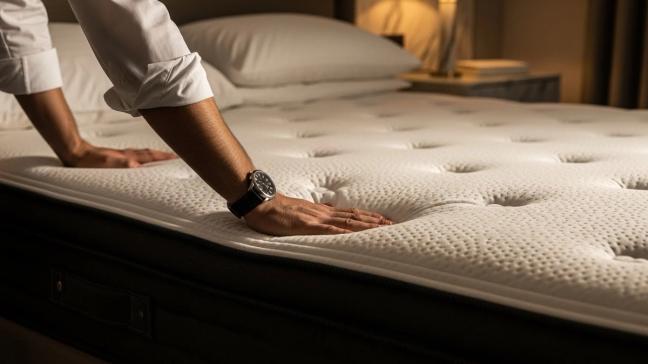
There is another layer to this, and it lives firmly in the realm of psychology and status.
Luxury bed makers trade in stories. Generations of craftsmanship. Royal households. Famous hotels. Limited editions. Beds that are numbered. Beds that can only be bought after a sleep consultation that feels vaguely like being interviewed by a benign spy service. None of that changes the laws of physics, but it absolutely changes what people are prepared to spend.
Flagship showrooms in expensive parts of London, Paris or Dubai do not pay for themselves. Nor do designers, collaborations, marketing campaigns or glossy brochures show tasteful people in linen pyjamas. When you pay luxury money, you are paying for the whole apparatus: the heritage, the theatre, the flattering idea that your bed is not merely functional but significant.
There is nothing inherently wrong with that. It is simply useful to recognise that part of the price belongs in the same column as tailored suits and Swiss watches. Function, certainly. But also signalling.
Where your bed is made has a polite but very real effect on what it costs.
A mattress produced in a vast factory on the other side of the world, using globally sourced commodity materials and automated processes, can be staggeringly cheap per unit. A mattress produced in a comparatively small workshop in Europe or the UK, using locally sourced wool, timber and steel, cannot compete on price without removing most of the reasons it exists.
Add to this the fact that truly high-end models are made in relatively small numbers. Fixed costs like premises, machinery, energy and training have to be recouped across far fewer beds. There are no giant economies of scale hiding in the background. It is niche manufacturing, priced accordingly.
Then there is the way these things actually reach you.
Some luxury beds are sold directly by the maker, either online or via their own showrooms. Others pass through interior designers, boutique retailers, department stores and hotel brands. Each layer adds a margin. When you buy the bed that a famous hotel has put its name on, you are also paying for the right to bask in that association. The manufacturer, the logistics company and the hotel all sensibly expect a slice.
Direct-to-consumer mattress brands in the upper price brackets have made a small industry out of telling you they cut out the middleman. They often do, and the prices look keener as a result, but even they have to pay for warehouses, customer service, advertising and the small matter of taking back a mattress if you decide you hate it after ninety nights.
There is no free version of a mattress that appears neatly in your bedroom and disappears again if you change your mind. Someone is always paying for the infrastructure, and if you are buying new, that someone is you.

That, as civil servants love to say, depends on your priorities.
From a cynical angle, luxury beds are expensive because they can be. A certain type of customer will always pay for a combination of comfort, craft, longevity and the warm glow of knowing their mattress has a more glamorous backstory than they do. Brands are not slow to notice this.
From a more practical angle, a good bed is one of the very few luxuries that also counts as a health intervention. It supports your spine properly. It reduces pain. It lets you sleep through the night. It helps you wake less exhausted and marginally less inclined to assassinate your alarm clock. When you divide the cost of a serious mattress by the thousands of nights you will spend on it, and by the improved quality of the days that follow, the economics begin to look less absurd.
You do not need the wildest thing in the showroom. You probably do not need a waiting list. What you do need is to stop thinking of your bed as a random rectangle and start thinking of it as the quiet piece of equipment that determines how you meet every morning.
The price of a luxury bed is the sum of its materials, its making and its mythology. The value is something you only really understand at 3 a.m., when you roll over, feel everything still supported and realise with some surprise that you are, in fact, perfectly comfortable.
To receive the latest in style, watches, cars and luxury news, plus receive great offers from the world’s greatest brands every Friday.