
Style -- 3 days ago

Waxed cotton was designed to resist the elements, not defy them forever. Its effectiveness lies in maintenance, patience and an understanding of what the material is meant to do.
Staring out of a window at what the forecast politely calls showers, most British men eventually have the same thought. Not about the state of the drains or the injustice of the climate, but about a coat hanging on the back of the door. The wax jacket looks reassuringly stout. It smells faintly of wet fields and dog. It has survived drizzle, farmers’ markets and at least one regrettable festival.
The question is whether it will survive this.
For all the romance about Barbour, Belstaff, and their waxed brethren, the modern world has become strangely technical about rain. Everyone talks about membranes and hydrostatic heads and taped seams, as if getting to the station were an alpine expedition. Somewhere between the marketing for mountaineering shells and the nostalgia for moorland, the wax jacket has ended up in an awkward position. Loved, worn, but quietly suspected of being more enthusiasm than engineering.
Time, then, for a reality check that will not upset the boot room.
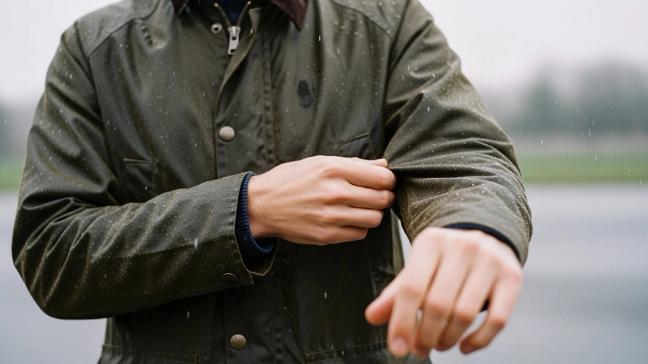
In the outdoor industry, nothing is allowed to be simple. Waterproof does not mean “I stayed quite dry, actually”. It means a piece of fabric has survived a lab ordeal in which water is piled on it until it gives up and leaks, at which point a number in millimetres is solemnly recorded. Fifteen hundred millimetres is often treated as the absolute entry level. Ten to twenty thousand is the sort of figure printed proudly on jackets that have their own vocabulary.
Those garments are built around laminated membranes, taped seams and patterns designed to funnel water away from every potential entry point. In short, they exist to allow people to trudge up hills in sideways rain and pretend they are enjoying themselves.
Waxed cotton operates on a different philosophy. There is no impressive test number on the label. Mills such as British Millerain and Halley Stevensons weave a dense cotton, then saturate it with wax so thoroughly that the gaps between fibres are essentially blocked. Water hits the surface, beads like mercury and rolls off. The fabric is not technically waterproof in the laboratory sense. It is simply very, very reluctant to get wet.
Barbour acknowledges the distinction by listing “waxed jackets” and “waterproof jackets” in separate categories. Belstaff talks of water resistance rather than impenetrability. The implication is clear. A wax jacket is a gentlemanly compromise, not a diving bell.
If your life consists largely of doing plausible things in implausible weather, a good wax coat is almost absurdly competent.
A freshly reproofed Barbour or Belstaff makes light work of what might be called normal British misery. Persistent drizzle, intermittent showers, gusty wind that seems to find a way through every gap in your scarf: all of this is cheerfully deflected. Water beads, runs, sulks a little at the seams, then gives up. You remain dry enough to walk straight into a meeting or a pub without looking as if you have just climbed out of a pond.
On dog walks, in fields, along towpaths, through city streets and across moors that are damp rather than biblical, waxed cotton comes into its own. It is heavy enough to feel protective, quiet enough not to rustle, and tough enough to shrug off contact with stone walls, brambles and car boots that have seen too much. It is, in other words, designed for the sort of weather and terrain most of us actually encounter rather than the weather we like to name-drop.
The secret is the maintenance. A jacket that has been brushed down occasionally and re-waxed within recent memory behaves like armour. Rain hits it and changes its mind. The shoulders, elbows and seams, if looked after, resist soak through for far longer than their slightly rumpled appearance suggests.
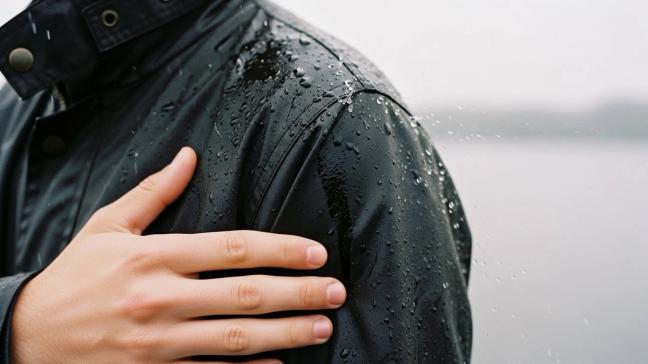
There are, however, limits. Wax jackets were never intended to be substitutes for climbing shells, and if you take them into that territory, they express their views quite clearly.
Prolonged, heavy rain is the enemy. Hours on a hill in a full Atlantic tantrum will eventually defeat waxed cotton in several predictable ways. Seams, which are not taped, begin to seep under sustained pressure. Shoulder tops compressed by rucksack straps can wet out faster, as the water is pushed, quite literally, through the waxed layer. The fabric itself has a saturation point, after which it stops repelling and simply becomes an expensive sponge.
Breathability is the other quiet issue. Waxed cotton breathes better than rubberised fabrics and the oilskins of old, but it does not come close to modern membranes in hard use. March uphill in warm rain, wearing a fully buttoned wax jacket, and you are likely to discover that although the weather has been kept at the appropriate distance, you have manufactured a private microclimate inside the coat. Damp is still damp, even if you caused it yourself.
This does not make the jacket a failure. It simply means you have asked a civil servant to do a commando’s job. The correct thing to blame, in that scenario, is not the coat.
How waterproof your wax jacket is on any given day depends, rather unromantically, on how recently you have bothered to look after it.
Barbour suggests roughly annual re-waxing for a jacket that is used properly. Belstaff and other heritage makers give similar advice, some a little more coyly than others. The logic is obvious once you put two specimens side by side. A newly treated coat has a rich, slightly tacky surface that sheds water with showy ease. An old one that has been ignored for years looks dry at the elbows and seams, patchy along the shoulders and dull across the back.
On the neglected example, the wax layers at flex points have simply worn away. The cotton is now closer to bare, and behaves accordingly. Rain clings, darkens the fabric and slowly creeps in. On the maintained one, those same areas are topped up and sealed, and the water does not get a chance to settle.
If you treat the tin of Barbour Thornproof Dressing as an optional accessory, your jacket will spend much of its life feeling heroic and not quite delivering. If you treat it as part of ownership, the waterproofing remains much closer to the level you fondly attribute to it in conversation.
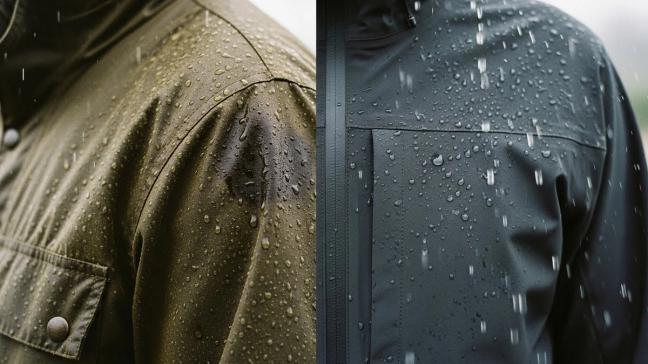
It is tempting to turn this into a gladiatorial contest. On one side, a Barbour Beaufort, smelling faintly of peat, spaniels and nostalgia. On the other hand, a three-layer technical shell with taped seams, a laminated logo and a price that could floor a horse. Which wins depends entirely on where you stand.
For hard days in serious hills, multi-hour deluges, winter cycling and anything where staying dry is a question of safety rather than comfort, the technical shell wins. It is lighter, its waterproof rating has been bullied into submission in a lab, its seams are sealed, and its fabric will continue to repel water at three in the afternoon in a storm in much the same way it did at ten that morning.
For everything else, the wax jacket makes a persuasive case. It is more abrasion-resistant. It is quieter. It can be repaired and reproofed rather than replaced when tired. It looks at home in a bar as it does at a farm gate. It takes on your life in its creases and marks rather than remaining permanently synthetic and unbothered.
The sensible man owns both and deploys them with the same pragmatism he applies to footwear. You do not wear velvet slippers to walk a dog through a bog. You do not wear a climbing shell to a long lunch followed by a walk along a windy estuary.
So, how waterproof is your wax jacket, in terms that matter rather than in numbers that never leave the swing tag?
You can expect it to keep you dry through commutes, dog walks, trips to the shops, a morning on a peg, an afternoon pitch side and most things the British weather throws at you in the course of a normal week. You can expect it to cope with hours of drizzle, spells of heavy rain punctuated by shelter, and sudden downpours as you walk between the station and the office.
You should not expect it to keep you bone dry during a full day out in catastrophic weather, nor should you expect a neglected, chalky-looking wax to perform like a recently reproofed one that still gleams faintly when you turn it in the light.
If you treat it as a highly weather-resistant, very competent coat designed for a civilised life in uncivilised conditions, it will rarely let you down. If you treat it as magical armour that defies physics, you will eventually find yourself in a kitchen, peeling off a heavy, soaked garment and muttering darkly about standards.
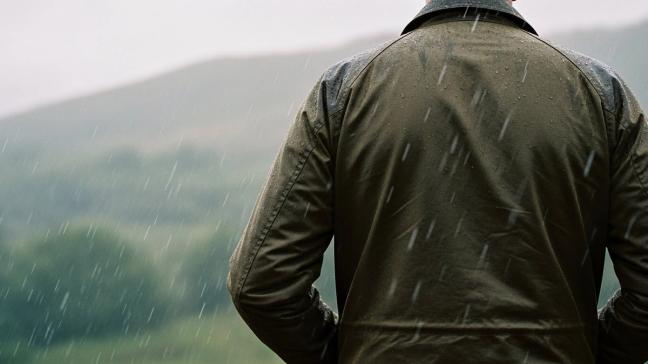
In the end, wax jackets are not miracles. They are dense cotton, cleverly treated, maintained by hand, worn by people who understand that the sky over this island is temperamentally unreliable. When kept in good order, they are extremely good at keeping that unreliability where it belongs.
Waterproof, in the strict technical sense, belongs to another category of clothing. Waxed cotton belongs to something older and in many ways more interesting: a tradition of garments that are meant to be fixed, fed more wax, and sent back out into the rain for another decade.
So the next time the forecast threatens mischief, and you reach for that familiar olive shape on the hook, know this. It will probably keep you dry enough, long enough, for the life you actually live. And if you are about to attempt something more dramatic, you already know you should be reaching for something less charming and more clinical.
To receive the latest in style, watches, cars and luxury news, plus receive great offers from the world’s greatest brands every Friday.