Food & Drink -- 2 hours ago

Cigar labels are not decoration alone; they are a quiet language of origin, construction and intent. Once understood, they reveal far more than strength or size ever could.
Cigar labels are one of those things a man nods at without remotely understanding. You pick up a cigar, admire the band, note the glint of gold and a flourish of Spanish, perhaps register a word like Reserva, then proceed as though it has all conveyed some vital information. In reality, for many otherwise competent adults, the band might as well be a small decorative flag from an unknown republic.
Which is a shame, because that little ring of paper, and the markings on the box it came from, are not decorative at all. They are a compact biography. They tell you who made the cigar, how long it expects to occupy your evening, how it is dressed, how it was assembled, and, with a little practice, whether you are about to make a sensible decision or something you will regret forty minutes in.
Reading a cigar label is not an obscure art. It is more like learning to read the care label on a suit. Once you know what you are looking at, you feel less at the mercy of chance and more in charge of your own evening.
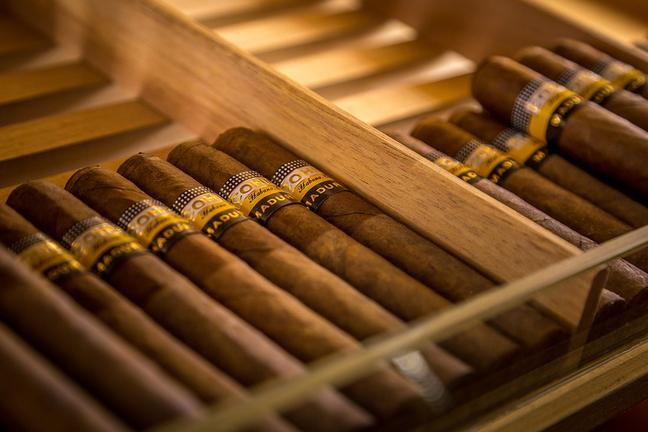
The first distinction is simple. The strip of paper wrapped around the cigar is the band. The various printed elements on and inside the box are the label in the broader sense. In casual conversation everyone calls the lot “the label”, but it helps to know where your information is hiding.
The band is the visible performance. It carries the brand crest, colours, sometimes the year, sometimes the series name. It wants to catch your eye across a humidor and communicate a certain level of prestige.
The box is where the bureaucracy lives. Lift the lid and you may see a decorative panel, but on the outside and underside you will also find stamps, seals, small print about where the cigars were made, how, and when they were boxed. On Cuban cigars in particular, the underside of the box is where the serious detail sits, in the form of factory codes and dates.
In short, the band is the handshake. The box is the paperwork.
Let us begin with the obvious part. The largest word on the band is the brand name. Cohiba, Montecristo, Partagás, Davidoff, Arturo Fuente, Padrón, Oliva, and their peers are not just logos. Each name carries an entire set of expectations about style, country, pricing and personality. Even if you know nothing else about a cigar, the house alone gives you a rough orientation.
The next layer is the line. This is usually printed just beneath or around the main logo. It is the answer to the question “which one of theirs is this”. Montecristo divides its world into families such as Línea Clásica, Open, Edmundo and so on. Davidoff runs Aniversario, Nicaragua, Millennium, Winston Churchill. Partagás labels certain cigars as Serie D or Serie P. Padrón marks out anniversary series from its regular production.
This is the difference between saying “I like that brand” and saying “I like that particular range”. The first leaves you wandering vaguely around a cabinet. The second lets you head towards the right box with something approaching intent.
Once you can connect brand and line, you can look at a humidor and say, for example, that you liked the Montecristo Edmundo but found the Open series a little underwhelming, or that you enjoy Davidoff Aniversario more than Davidoff Nicaragua. That is the level of knowledge that actually changes what you buy.

Cigar people love grand size names. Robusto, corona, churchill, toro, double corona, belicoso. They sound charming until you remember that you are the one who has to sit there and smoke them. Underneath the romance there are only two measurements that really matter: length and ring gauge.
Length is measured in inches. That much is obvious. A classic robusto sits around five inches. A churchill wanders up towards seven. A double corona extends further still.
Ring gauge is the diameter, expressed in sixty fourths of an inch. A cigar described as 50 ring gauge is fifty sixty fourths of an inch thick, just under twenty millimetres. The higher the number, the fatter the cigar, and the more tobacco you will be working through.
On boxes and product cards you will often see both the traditional size name and the numbers. Something described as Robusto 5" x 50 is telling you that you are looking at a solid hour, possibly more, depending on how industrious you are. A corona at 5" x 42 is closer to a forty minute interlude. A double corona at 7" x 49 is an evening.
This is not trivia. It is scheduling. Glancing at those numbers before you buy avoids the classic amateur mistake of trying to wedge an enormous double corona into the twenty minutes before a table booking, then either abandoning it half smoked, or arriving at dinner smelling faintly of a controlled burn.
If you get into the habit of checking length and ring gauge, and mentally linking them to how long you usually take to smoke, you will choose with far more confidence and far fewer small tragedies.
If the cigar were an item of clothing, the wrapper would be its cloth. It is the outer leaf, the one you see, and it has a disproportionate influence on both look and taste.
Most reputable makers are open about what they have wrapped your cigar in. On the box, on shelf cards, and increasingly in online descriptions, you will see terms such as Connecticut or Connecticut Shade, Habano, Corojo, Sumatra, San Andrés, Maduro, Oscuro. Sometimes a country is added: Ecuadorian Habano, Brazilian Maduro, Nicaraguan Corojo.
As a rough guide, paler Connecticut wrappers tend to produce a softer, creamier, generally milder experience. Habano and Corojo sit in the middle ground. They are browner, a little spicier, with more structure. Dark maduro and oscuro wrappers lean towards chocolate, coffee, molasses, and the sort of richness that feels perfectly appropriate after a serious dinner and slightly alarming before lunch.
Origin is the second part of the story. Somewhere on the band or box you will find a phrase indicating where the cigar was made. Handmade in Nicaragua, hecho en República Dominicana, hecho a mano en Honduras. This is not travel writing. It is a clue.
Nicaraguan cigars often bring earth, darker spice and a more muscular profile. Dominican cigars tend to be smoother, with more floral and cedar notes. Honduran blends occupy their own ground. None of this is iron law, but if you pay attention you will quickly discover that certain countries of origin recur among cigars you enjoy, and others less so.
The combination of wrapper and origin is rather like a fabric description and a country of tailoring on a suit label. Even before you try it on, you have a decent idea of the kind of experience you are in for.
Once you have decoded the obvious elements, your attention can turn to the parts most people ignore, the small print around the band and the fine lines on the box.
Cigar makers are fond of Spanish phrases that sound pleasantly official. A few matter more than others. Hecho a mano tells you the cigar is made by hand, at least in part. Totalmente a mano tells you that the rolling is entirely by hand and, in practice, usually that long filler leaf has been used.
On non Cuban cigars you may see straightforward English equivalents, and sometimes a direct reference to long filler. That phrase is worth noticing. Long filler means that the filler tobacco runs the full length of the cigar, which generally leads to a steadier burn and a more coherent flavour journey. Short filler, or a phrase that hints at chopped tobacco, belongs at the more casual, inexpensive end of the spectrum.
Then there is the language of special status. Reserva, gran reserva, edición limitada, vintage, aged five years and similar claims are attempts to tell you that this is not quite standard production. Sometimes that is absolutely true. Certain houses are scrupulous about only using these words for cigars made from older tobaccos or produced in genuinely limited runs. Others are, let us say, more relaxed.
Here the label can only take you so far. You have to lean on the reputation of the brand and the honesty of the retailer. A limited edition from a serious, established house is one thing. A limited edition from someone who appears to have opened a factory last week is something else.
Nevertheless, knowing the language allows you to ask better questions. Instead of nodding vaguely at a gold secondary band that says Reserva, you can look at the person behind the counter and ask precisely what is supposed to be different about this box from the standard line.
With Cuban cigars there is a separate little universe of information under the box, and once you have noticed it, you will find yourself turning boxes over with slightly guilty enthusiasm.
Along with the familiar Hecho en Cuba and Totalmente a mano, there will usually be two codes stamped into the wood. One is a factory code, a short cluster of letters indicating where the cigars were rolled. The other is a date code, which tells you the month and year the cigars were boxed.
There are people who can tell you, from those codes alone, not only where and when the cigars were made but what the general quality from that factory was like that year. There is no particular need to become that person unless you find the idea appealing. However, even a basic understanding is useful.
If a box of cigars was packed in the last few months, you can expect them to be relatively young. Some Havana cigars smoke well almost immediately. Others are noticeably better after a year or two of quiet rest in a decent humidor. If the date on the underside tells you that your cigars have already sat for three or four years, you are looking at something rather different to a box that left the factory last Tuesday.
This is the cigar equivalent of a vintage on a wine label. It is not a guarantee of quality, but it is a piece of context that helps you decide whether to smoke now or later, and whether a given price makes sense.
You will also see warranty seals and, on more recent boxes, holograms and scannable authenticity stickers. These are part of the modern campaign against counterfeiting. Again, you do not need to know every design change by heart, but being aware that they exist, and glancing at them rather than ignoring them, is simply sensible behaviour if you are spending meaningful money.

In many markets the first thing you see on a cigar box is no longer an elegant brand crest but a health warning the size of a small novel accompanied by medical photography. None of this tells you anything useful about the character of the cigar. It simply announces that the box has passed through a particular customs regime.
What it does do, unfortunately, is obscure the more interesting printed elements. If you are in the UK or EU, the factory and date codes on Cuban boxes, and sometimes the finer details of the main label, lurk beneath mandatory stickers and warnings.
There is no shame in gently lifting these to find the information you actually need. Everyone else in the shop is doing exactly the same thing. You are not denying the reality of health advice. You are simply refusing to let it obscure the details that turn guessing into judgement.
All of this is entertaining in theory. Its value lies in what you actually do in front of a humidor.
Imagine you are in a decent shop. You have an hour, perhaps a little more. You would like something medium in strength, not too imposing, quality enough that you feel you have treated yourself, but not so dramatic that you will spend the rest of the afternoon feeling as though you have swallowed a small radiator.
Rather than pointing vaguely at whatever looks handsome, you can now move through a very simple sequence.
You look at the brands and head for houses you know you tend to enjoy. Within those, your eyes go to lines that have served you well before. You ignore the larger and more aggressive sizes because you know you do not have time for a double corona today. You pick up a robusto and check the length and ring gauge to confirm that it will give you roughly the duration you have in mind.
You read the wrapper information and notice that one cigar uses a dark maduro leaf and is labelled full bodied, which does not align with your current plans, while another uses a habano wrapper and is described as medium. You notice that one is Nicaraguan made and the other Dominican, and recall that you tend to like Dominican blends when you are trying to remain presentable for the rest of the day.
If you are buying Cubans by the box, you might quietly turn it over and look at the boxing date, deciding whether the cigars are likely to be ready to smoke now or better kept back for a future occasion.
Nothing about this process is complicated, and none of it requires you to speak in tasting notes. It is simply a way of making the labels work for you, rather than for the marketing department.
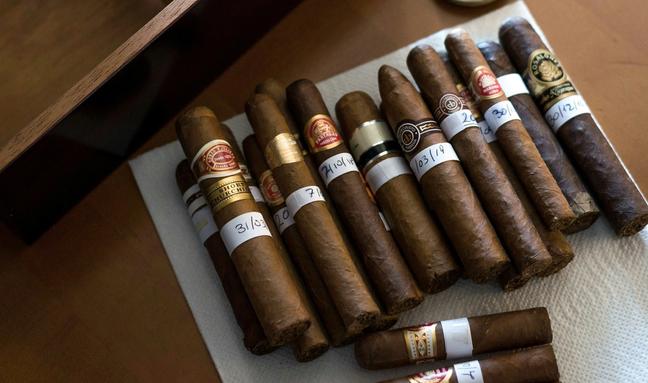
The point of learning to read a cigar label is not to become a bore. It is to replace blind chance with mild, private competence.
You will still discover cigars that do not suit you. You will still, very occasionally, fall for something that looked wonderful and turned out to be all packaging and no performance. That is part of the game. The difference is that you will know why. You will be able to say that the size was wrong for the time you had, that the wrapper style does not agree with you, that you bought something too young or too powerful for the situation.
You will also experience the quieter satisfaction of getting it right. Sitting down with a cigar from a house you like, in a line you trust, in a size that matches the next hour of your life, dressed in a wrapper and origin you know you enjoy, at an age that suits the blend, is a small but genuine pleasure. When you can trace those elements back to the labels you read in the shop, the whole ritual feels less like gambling and more like judgment.
In the end that is what separates the gentleman from the punter. Both may enjoy the same cigar. Only one can explain, calmly and without fuss, why he chose it.
To receive the latest in style, watches, cars and luxury news, plus receive great offers from the world’s greatest brands every Friday.