
Style -- 3 days ago

“The marketing always maintained that the inspiration for the Golden Ellipse was guided by the titular ‘Golden Rule’ – the ‘perfectly proportionate’ relationship between height and width,” recalls Jean-Pierre Frattini, a young casemaker who had joined Patek Philippe in 1962 when Geneva’s grande dame was getting its groove on – to the surprise of a notoriously stuffy firmament, more used to classically circular dress watches like the Calatrava, designed back in the Thirties.
However, M. Frattini – tasked with the challenge of wrangling yellow gold into a newly contemporary, slimline, yet still-hardwearing guise – recalls a rather more prosaic explanation:
“Monsieur Delessert, the director of the electronics department, said himself that the Ellipse was instead inspired by the ‘pleasing shape’ of an American highway junction, which he observed from his airplane window, on a business trip.”
Diplomatically, however, Frattini has historically reconciled the two accounts, conceding, “The concept of our new Golden Ellipse of 1968 may well have been inspired by the aerial view a road junction, but the actual design process of the Ellipse was necessarily informed by the Golden Rule."
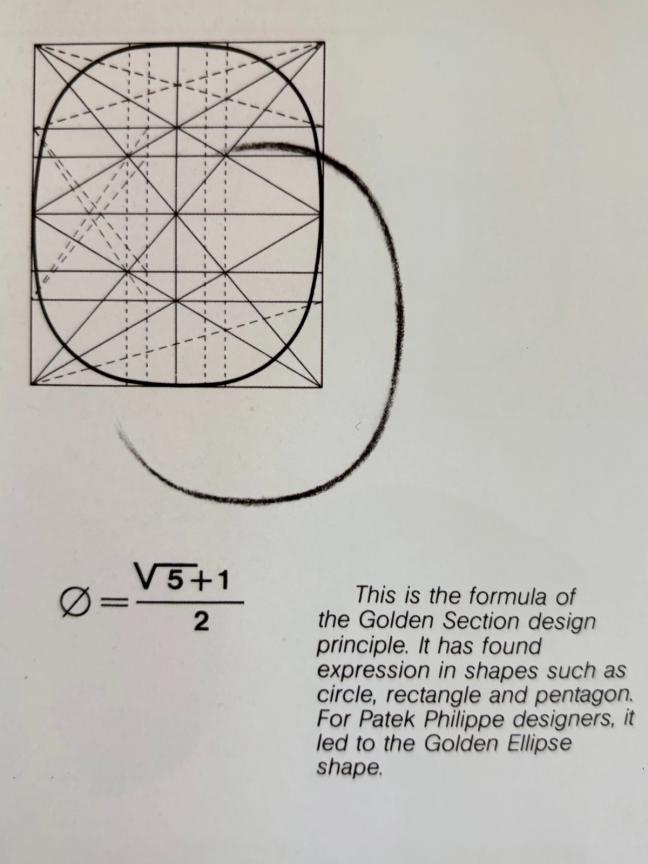
Whether adhering to every artist’s go-to ‘divine’ ratio or the concrete creativity of transatlantic roadbuilders, Patek Philippe’s enduringly coquettish ‘cocktail’ design – neither circle, nor rectangle, nor oval – would have been surprising enough. But what really set Patek’s unlikely mid-century icon apart was its cobalt-blue dial.
Not a sliver of semiprecious stone, nor a delicate piece of enamelwork; it was instead something that no one had seen before: funkadelic, 18-carat blue gold. A literal slice of unadulterated, international, jetsetter chic. Anachronistically unisex and – for want of more adverbs – unbelievably bold for such a traditional watchmaker.
In turn: the Golden Ellipse became an instant, cultish sub-brand. It took a particularly churlish mathematician to take the actual time to calculate the dimensions of the Golden Ellipse and point out that the watch didn’t actually adhere strictly to the ‘golden ratio’, but nobody by that point was taking any notice anyway.
The case’s dimensions certainly has its roots in the golden ratio – roughly 1:1.618, or where a 2D shape’s long and short dimensions share the same ratio of long plus short dimensions to long. Ultimately, a very humane balance; think Greek temples or Whistler portraits – just two reasons why tourists continue to flock to Athenian temples or Vermeer retrospectives at the Rijksmuseum for divine aesthetic satisfaction.

This mathematical underpinning was more than mere clever marketing at a time when Patek Philippe was outstripping its historical contemporaries; it gave the Golden Ellipse a refined, sculptural quality that helped it feel timeless the moment it arrived.
Such was the almost occult power that this watch exercised that by the late 1970s, the Golden Ellipse line had expanded dramatically, with more than 60 variants available. Some featured different case sizes, others were offered on braided or mesh bracelets, and a variety of dial colours and finishes were introduced. The design also transcended mere timepieces: matching accessories such as cufflinks, rings, lighters, and even key chains were produced, showcasing the cultural cachet and desirability of the ‘Ellipse’ motif.
"Hundreds of small pieces of gold came under the blow-lamp and were tested in scores of ways," gushed France’s monthly art authority at the time, Connaissance des Arts. “The result was a new technique for treating gold and the appearance of a new metal, with a grain of its own, and with warm tones subtly ranging from copper to a silver that is almost white. This Patek Philippe innovation is still in the process of development.”
In 1977, a major technical evolution occurred when the Golden Ellipse was fitted with Patek Philippe’s ultra-thin automatic calibre 240, featuring a sophisticated off-centre micro-rotor. This allowed the watch to maintain its slender profile while offering the convenience of automatic winding, cementing its appeal for discerning buyers seeking both style and mechanical excellence.

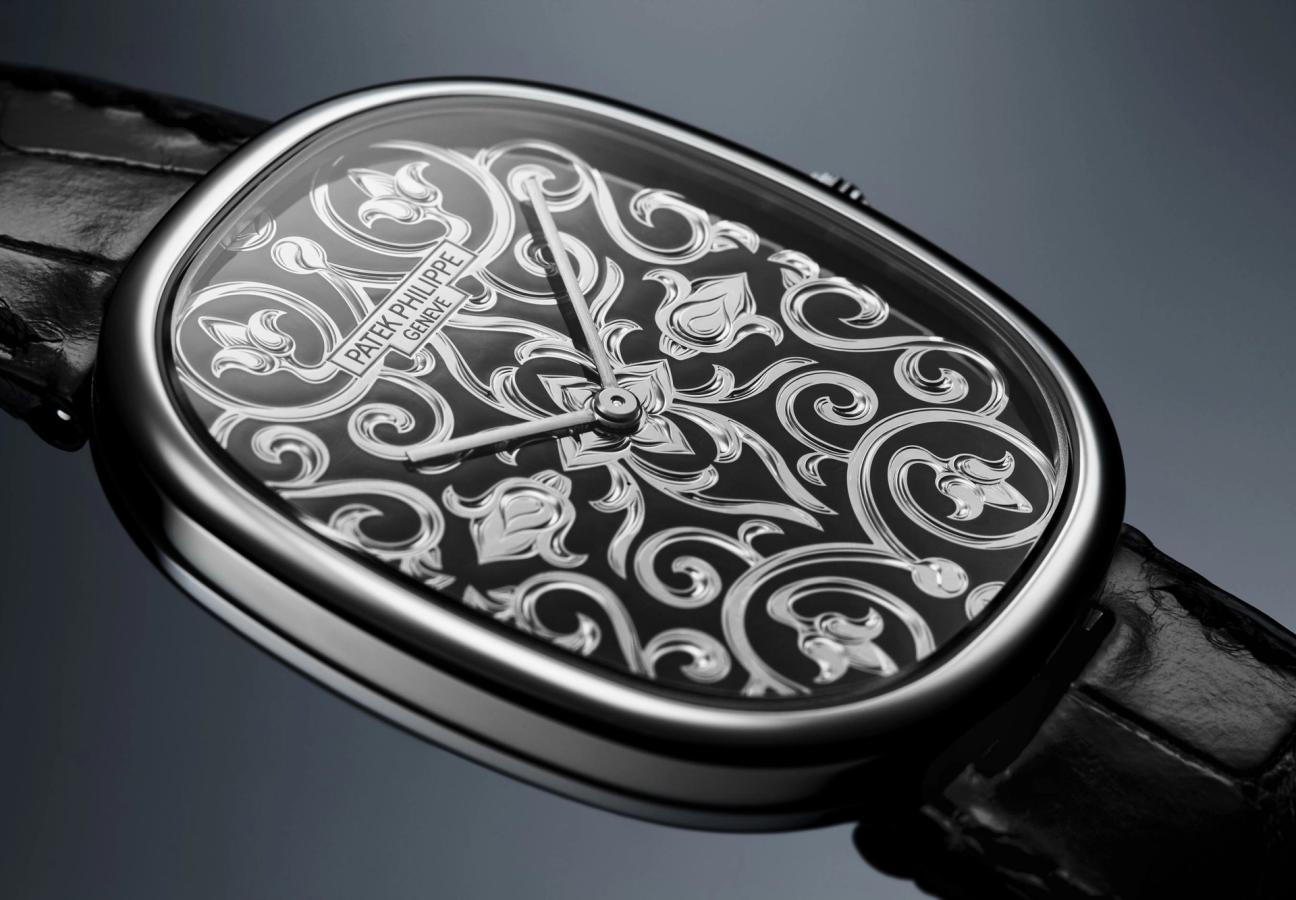
The model continued to evolve over the decades. In 2008, the Golden Ellipse celebrated its 40th anniversary with the launch of a platinum ‘jumbo’ edition that preserved the classic aesthetic but in a larger, contemporary size. Later, bespoke artisanal pieces incorporating rare hand-engraving and tortuously, repetitively painted-then-fired grand feu enamel dials.
By 2018, the Golden Ellipse had reached its 50th year of unbroken production, prompting special editions and underscoring its remarkable longevity in an industry driven by trends.
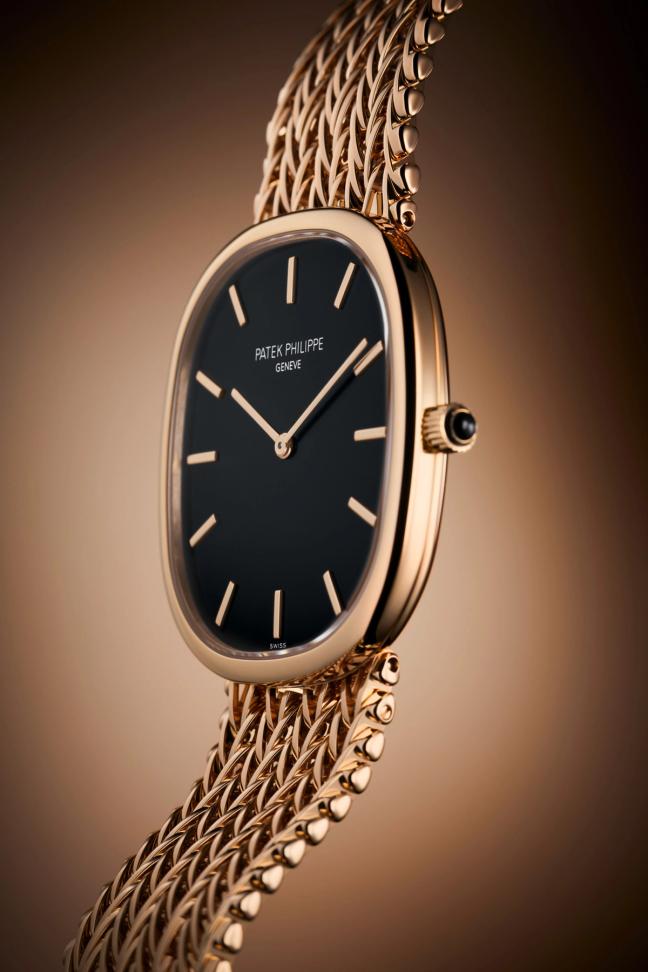
The current, large-sized Golden Ellipse Reference 5738 is now available in platinum (£53,090) and also on a beautifully crafted gold-metal bracelet for the first time. Composed of links set in fine rows reminiscent of chain bracelets, this supple, elegant chain-style bracelet in rose gold pays a fine tribute to the 1970s heyday of the watch.
And couldn’t be less higher in altitude to the spaghetti junctions of Americana.

To receive the latest in style, watches, cars and luxury news, plus receive great offers from the world’s greatest brands every Friday.