ONE TO WATCH: The (antimagnetic) IWC Ingenieur’s 50 years of magnetic appeal
IWC marks five decades of Gérald Genta’s cult steel sports watch with two limited-edition, chronometric models that marry 1970s flair with serious antimagnetic engineering.
- Words by: Alex Doak
Fifty years ago, in 1976, IWC Schaffhausen introduced the ‘Ingenieur SL’, ref. 1832. The long-overdue successor to the Swiss watchmaker’s 1950s ‘Ingenieur’ was, in a pen stroke, commuted from ‘engineer’ to ‘boulevardier’ by none other than Gérald Genta.
A democratised instrument for the wrist, still as cosmopolitan, still as fit for industrial purpose than ever, it’s now celebrated by two equally fit-for-purpose antimagnetic, chronometric limited editions in steel, 35mm and 40mm respectively.
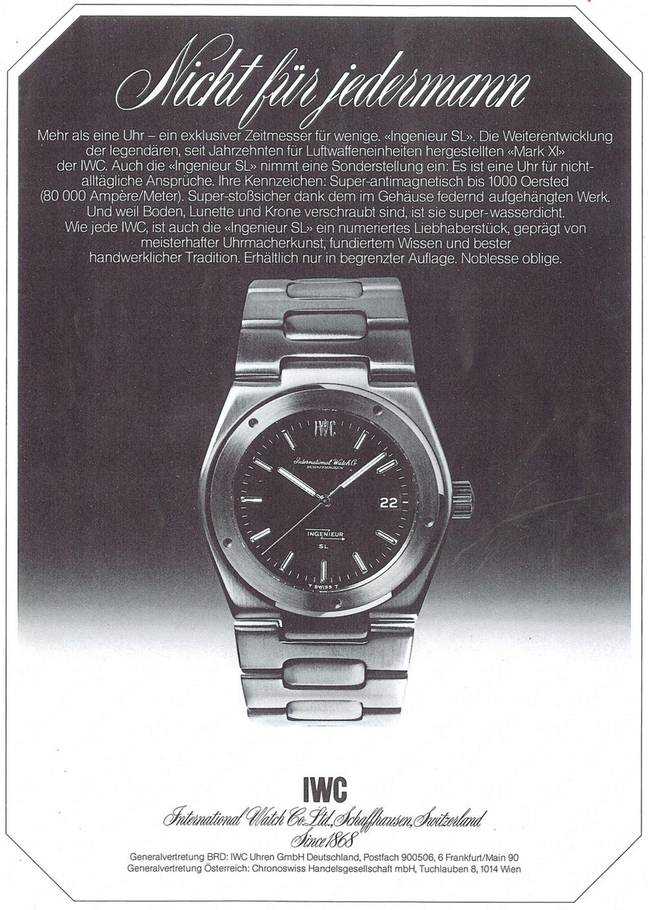
An original advertisement for Gérald Genta’s Ingenieur SL, the steel sports watch introduced in 1976.
Readers of The Gentleman’s Journal will require little introduction to Monsieur Genta. The Geneva-based artist and watch designer conceived this bold design at the height of his creative powers in the 1970s, a decade in which his idea of a ‘luxury’ steel sports watch with flowing, integrated bracelet emerged as an entirely new category within Swiss watchmaking. Genta’s extraordinarily influential portfolio commencing, of course, with 1972’s octagonal, cock-of-the-quayside-walk ‘Royal Oak’ for Audemars Piguet – a rush job for the ever-dapper Italian market, immune to the cheapening of watchmaking being wrought by Far Eastern quartz tech’ at the time.
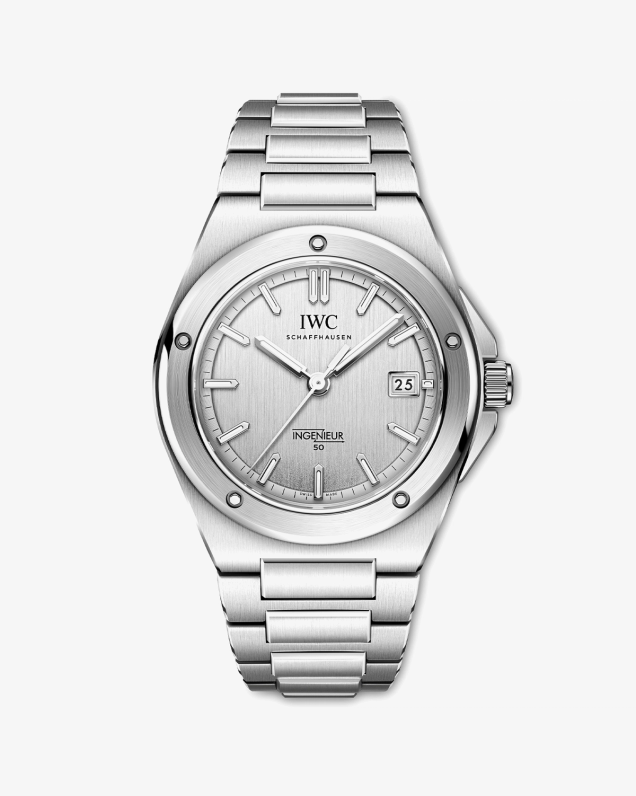
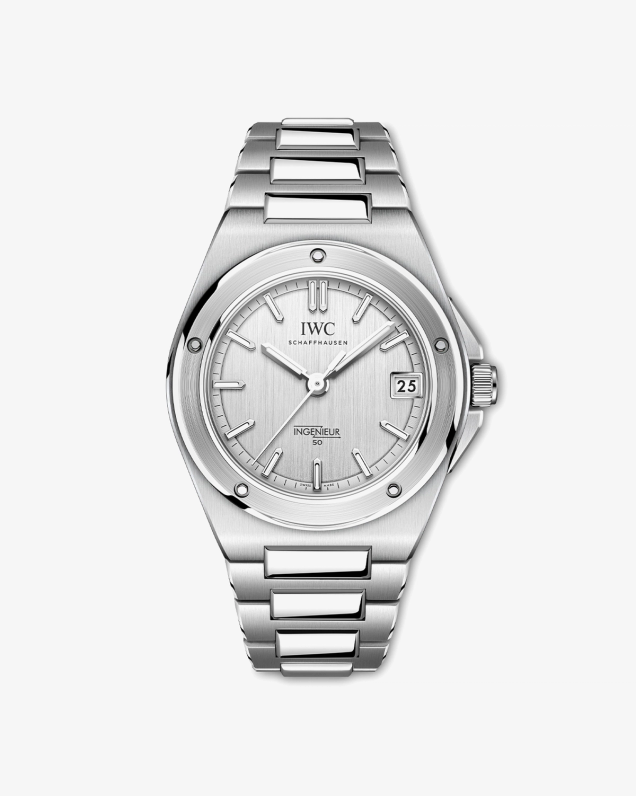
Since re-launching in 2023, Genta’s 1976 reimagining of the Ingenieur, with all his cues intact, has grown into a full collection spanning multiple sizes, materials and complications, and IWC is now celebrating five decades of the ‘Ingenieur SL’ with two limited editions. Both stand out with their refined brushed silver-plated dials, which are inspired by a rare variant of the Ingenieur SL, including an unprecedented ’50’ logo update to the brushed steel dials.
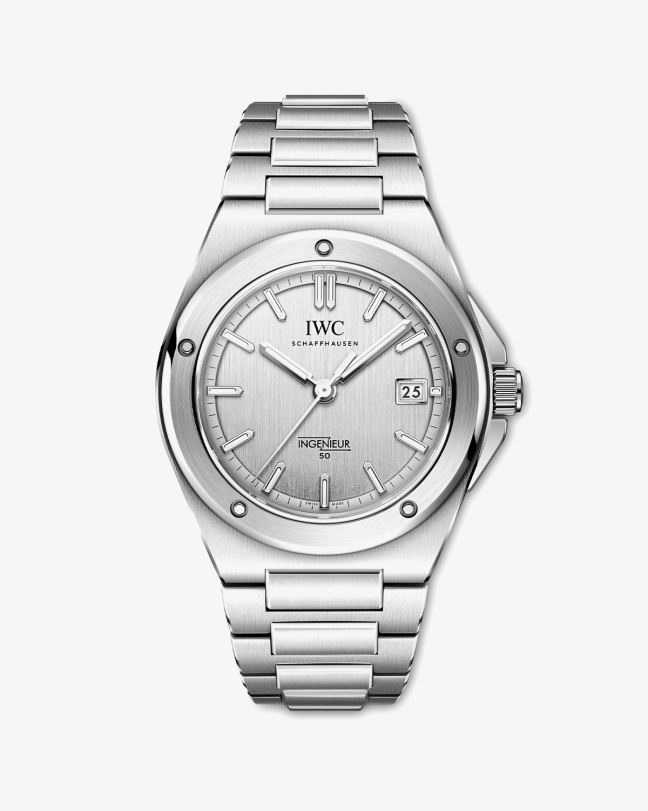
The Ingenieur Automatic 40 50th Anniversary pairs a brushed silver-plated dial with a commemorative ‘50’ signature.
Despite its forward-looking design language, the Ingenieur SL was not a commercial success at launch. Even by the brand’s own admission, it took decades for collectors to rediscover the watch – of which between 1976 and 1983 only 598 pieces were made – and today it ranks among the most sought-after models in IWC’s history.
“Fifty years have passed since my father created the Ingenieur SL,” says Alexia Genta, daughter of Gérald Genta and co-founder of the Gérald Genta Heritage Association. “It continues to amaze me how his work continues to inspire so many people decades later.”
Even given the much-ballyhooed Oak and subsequent exercise in eight facets for Patek Philippe, the Nautilus, it says everything of the Ingenieur ’SL’s enduring appeal that she see fit too attest: “I am honoured to see how IWC is preserving his artistic legacy and building on his iconic design.”
Whether you’re talking Ingenieur, Pilot’s, Portofino or Portuguese, from the very outset, American industrialist Florentine Ariosto Jones chose to set up his high-tech factory in the German-speaking town of Schaffhausen in 1868, dubbing it ‘International Watch Company’, cleverly harnessing the skills of Swiss workers, the efficiency of his imported US-made precision machinery as well as the mighty hydropower of the neighbouring Rhine river to engineer precision timekeepers defined by their very purpose.
And sure enough, ever since Richemont Group took ownership in 2000, a historically respectful suite of antimagnetic pilot’s watches, diving innovations, modern takes on haute horlogerie complications, you name it, have all been nurtured in an increasingly self-sufficient manner.
Ingenieur, and then Ingenieur SL, and then this year’s 50th Ingenieur could be all you need when it comes to the oft-trotted ‘DNA’…
The Ingenieur’s story arguably started in 1944, when 12 Swiss watchmakers had the job of turning out high-grade wristwear for allied infantry, according to the British MoD’s strict ‘Watch. Wrist. Waterproof.’ spec of high-legibility ruggedness, legibility and… antimagnetism, given cockpits’ ever cock-pit-like throng of electrics.
To collectors, assembling the complete ‘Dirty Dozen’ suite is the Holy Grail. To IWC, W.W.W. was mere prototype to its legendary Mark 11 of 1948, which remained in service to RAF pilots till 1981.
After the war, science and engineering boomed – hence, come 1954, IWC launching a no-frills instrument for the wrist, fit for pipe-smoking boffins. The requirement of a wristwatch that could be used in laboratories, where exposure to strong magnetic fields was often unavoidable, had become increasingly important. IWC was one of the first firms to introduce a civilian version of their anti-magnetic wristwatch.
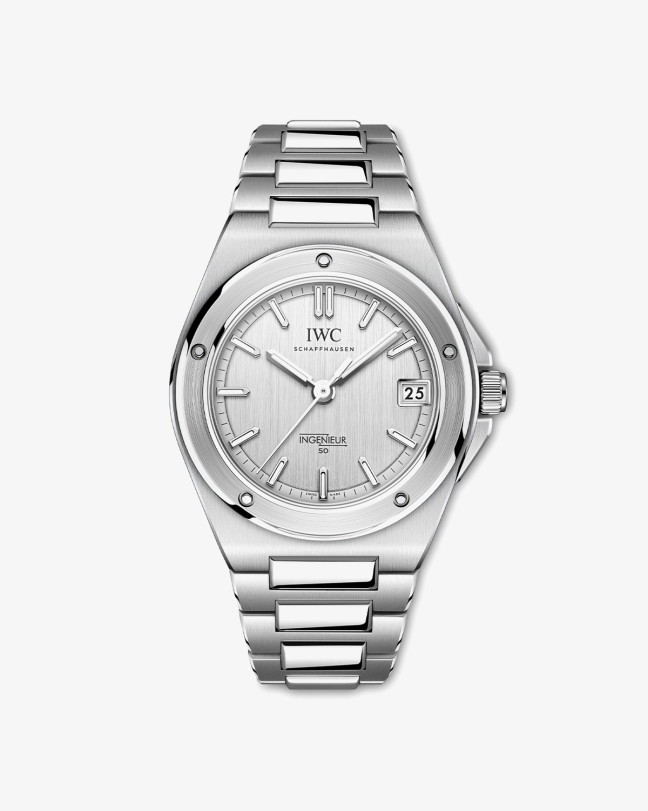
The Ingenieur Automatic 35 50th Anniversary offers the same anniversary dial in a smaller case, complemented by polished bracelet centre links.
This new watch, launched in 1955 and named the Ingenieur, was designed, thanks to a ‘soft iron’ inner core case construct, to withstand magnetism of 1,000 Gauss (Gauss being a measurement of magnetic induction in the ‘A’ field – 10,000 being equivalent to 1 Tesla, and no, not an electric car. And don’t get us started on the ‘H’ field of magnetism being measured in Amperes per metre…)
Soon after the Ingenieur’s introduction, Rolex released their own specialist anti-magnetic watch, the Milgauss. Like the Ingenieur, the Milgauss also used a soft iron ‘cage’ to surround the movement and protect the watch from magnetism. The model was also guaranteed to resist magnetic fields up to 1,000 gauss.
That was the science bit. And then there was the Genta bit. And now here’s the modern fit, powered by Richemont’s ValFleurier imprint’s rocksolid self-winding mechanics. More future-forward than ever, thanks to today’s (probably not pipe-smoking) boffins.
For more information visit iwc.com.