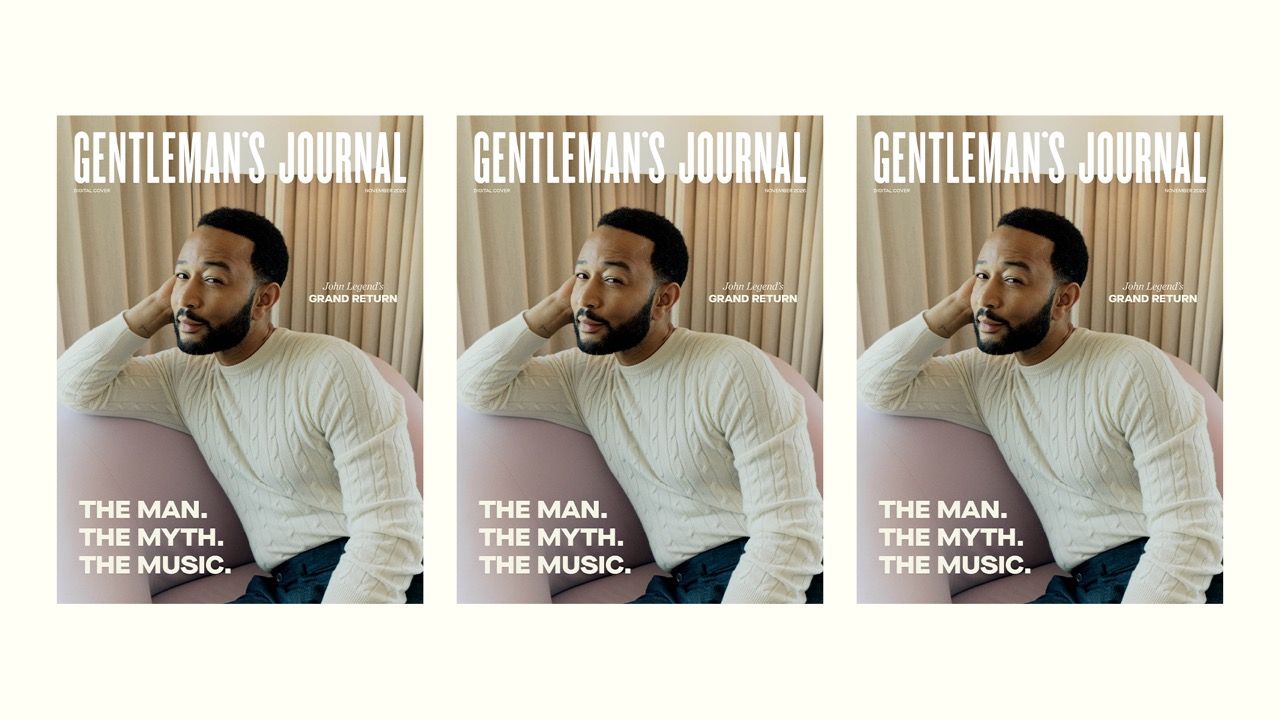
The man, the myth, the music: John Legend’s grand return
More than two decades into his career, the EGOT winner returns with a new album. At the Regent Santa Monica, we asked Legend: how does he summon the muse?
- Words by: Jonathan Wells
- Photography: Victoria Stevens
- Stylist: David Thomas
- Groomer: Pamela Farmer
- With thanks to: Regent Santa Monica
“Sing to me of the man, Muse, the man of twists and turns.” Recognise that opening line? John Legend would. He first read The Odyssey back in high school, long before his own life’s twists, turns and tremolos. Not that 1996 translation by Robert Fagles, of course. Legend probably read Samuel Butler’s, whose 1900 version begins, “Tell me, O Muse, of that ingenious hero,” or maybe Richard Lattimore’s 1965 effort, which opens, “Tell me, Muse, of the man of many ways.”
Who’s to know? What matters is that, across all these translations, one word endures: Muse. As it happens, that’s also the title of Legend’s latest album. “You know, people think a muse is just someone who gives you inspiration,” he says, dialling in from the far shores of California. “But when we dug deeper into Greek mythology, it was cool to read up on the muses and discover these nine goddesses, muses of everything from art and history to science and culture. Everything, really, that makes up life.”
Even ‘music’, Legend points out, derives from ‘muse’. So perhaps it’s fitting that, when Christopher Nolan sought a contemporary voice to invoke Homer in his epic, he turned to rapper Travis Scott. Legend, who saw The Odyssey this summer, has history with Scott, having worked alongside him (and a wider pantheon of hip-hop heavyweights) on 2012 album Cruel Summer. He sees the logic in Nolan’s choice, sharing the director’s view that oral poetry is “analogous to rap”. “I heard from someone that people were singing before they were talking,” he says. “I don’t know if that’s true, but it’d be interesting to speak to an anthropologist about it. Either way, music is so important to storytelling, and to the way we interact. It’s core to our culture.”
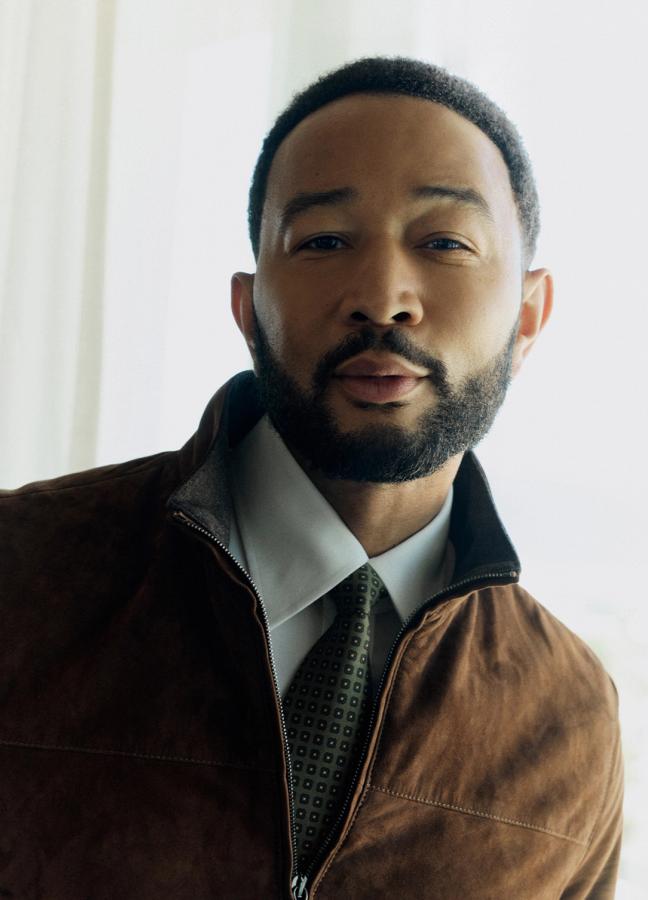
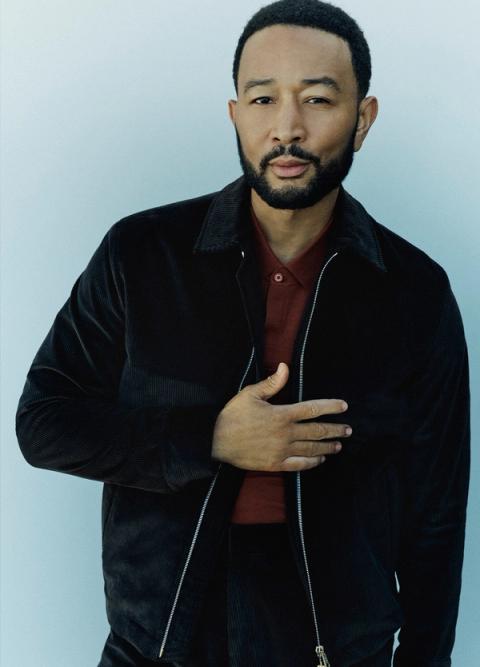
Jacket, shirt and tie by Thom Sweeney.
It’s certainly been core to Legend’s life. Born John Roger Stephens, he was playing piano at four; a church-choir prodigy by seven. That high school — the one with Greek epics in the library — was in Springfield, Ohio, where Legend graduated salutatorian before heading to the University of Pennsylvania. There, he became president of the award-winning a cappella group The Counterparts. He played piano on Lauryn Hill’s debut album, began working with Kanye West in 2001 and secured his first record deal, with Columbia, three years later. By 2014, five albums in, Legend finally conquered charts the world over with ‘All of Me’, a swooning paean to devotion. The song knocked Pharrell Williams’ ‘Happy’ off the top spot. Williams, happily, bears no ill will; indeed, he was instrumental in the making of Muse. But more on that later.
For Legend’s own legend was sealed with ‘All of Me’. (Coincidentally, the song also marked the first time he used the word ‘muse’ in a lyric.) The 14-times-platinum single became a phenomenon, raising formidable expectations for his next album, 2016’s Darkness and Light. At the time, he said of that sixth album: “My friends that have listened to it think it’s my best album yet. I think it is too, but I always think that after every album.” A decade on, does he feel the same about Muse?
“I do feel like Muse is my best yet, but don’t trust me!” Legend laughs. “Let the people decide. Albums mean different things to different people. They hit you at different moments in your life. For many, Get Lifted was part of their college experience or their first big relationship. Some people proposed to Love in the Future. So an album isn't just what it is as a piece of art. It also means different things to different people, at different moments in their lives.”
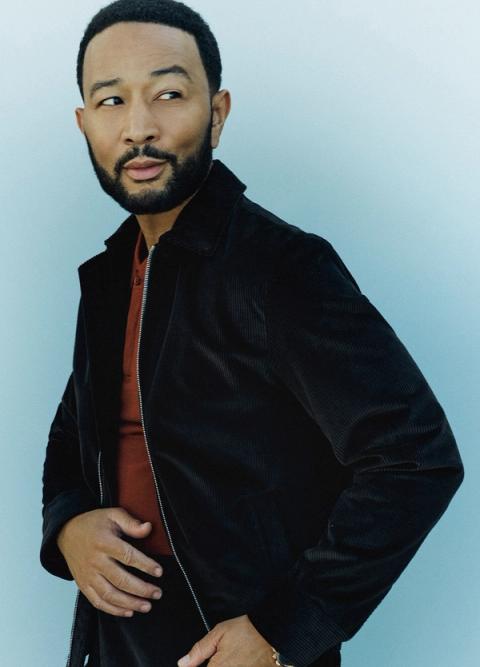
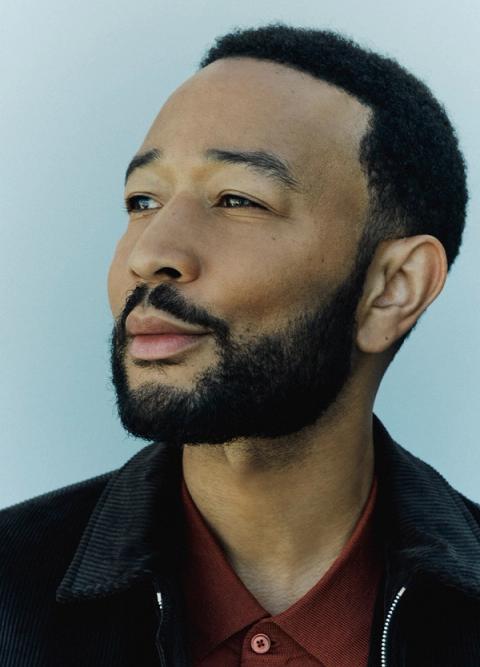
A decade has also passed since Legend appeared in La La Land, delivering a cucumber-cool turn in the Oscar-winning musical, for which he also wrote the slick, brass-laced ‘Start a Fire'. He'd admired director Damien Chazelle's previous film, Whiplash, for its authenticity. “I seldom see films about music that feel that real,” he says. “Or that have that level of grit and raw intensity. Whiplash felt specific and powerful. It was one of my favourites of that year.”
Chazelle first approached Legend with an idea. And, when the director revealed his intention to make “a modern Hollywood musical”, Legend was sold. “I thought it was such an ambitious, cool idea. I loved working with Damien. Ryan [Gosling], too. The level of commitment he had, really learning to play these intricate jazz pieces on piano, I was so impressed. It was a beautiful film, a love letter to music and to that spirit of artists who dream big.”
“I seldom see films about music that feel that real…”
It wasn’t Legend’s first spin on the Hollywood turntable. In 2015, having co-written ‘Glory’ for Ava DuVernay’s Civil Rights drama Selma, he won the Academy Award for Best Original Song. (That was the second piece of his EGOT puzzle, having picked up the Grammy for Best New Artist back in 2006. He'd complete the set with a Tony in 2017 and an Emmy the following year.) His next career move sees him twist and turn back to the big screen, playing fellow EGOT winner Harry Belafonte in The Road Home.
“Which isn’t really about Mr Belafonte,” says Legend. “It’s more about Paul Simon, Hugh Masekela, Miriam Makeba — and Paul Simon’s journey to Africa to collaborate with African artists on Graceland. It was controversial at the time, because of the cultural boycott in place against South Africa’s apartheid regime. It was obviously a very impactful album, but there was a lot of story around it, and the film really explores that.”
Legend knew Belafonte, who died in 2023. “In the last ten years of his life, or so,” he nods. “He really was an elder statesman, an adviser to actors, musicians, politicians. We got to spend a decent amount of time together, and did some really positive work around criminal justice reform. I got to hang out with him, hear all these stories he had to tell, and listen to his advice. So the chance to play him? Pretty cool.”
Having known Belafonte personally, Legend was particularly keen to get it right. “Having spent time with him, I had some sense of his demeanour and way of speaking. I also revisited interviews with him, as well as recordings of his songs with Miriam Makeba, who's played by Cynthia Erivo in the film. We have two songs together. I just wanted to soak up his energy and hopefully do him justice.”
If Graceland merits a film of its own, which of his albums would Legend nominate for the same treatment? “Honestly, maybe Muse. We got to make it in Paris, and what a beautiful world to be in as we created the album. It’s a pretty cool story.”
He's not wrong. But why Paris? That's where Pharrell comes in. Williams and Legend have been friends for more than twenty years, but Muse marks the first time the pair have made an album together. Yet Williams's day job — as men's creative director at Louis Vuitton — meant the recording sessions had to be relocated to the French capital. And so Muse took shape amid Belle Époque boulevards and Beaux-Arts façades – a far cry from the Harlem clubs where Legend first crossed paths with fellow musicians, Kanye West among them.
“Although that would make an interesting story, too,” says Legend. “My beginnings. You know, Kanye and I as young artists trying to be heard, trying to get a record deal, getting turned down. The hunger we had back then and the audacity to believe we had something special to offer the world. The rejection, the challenges — then persisting and powering through until we got the breaks we needed.”
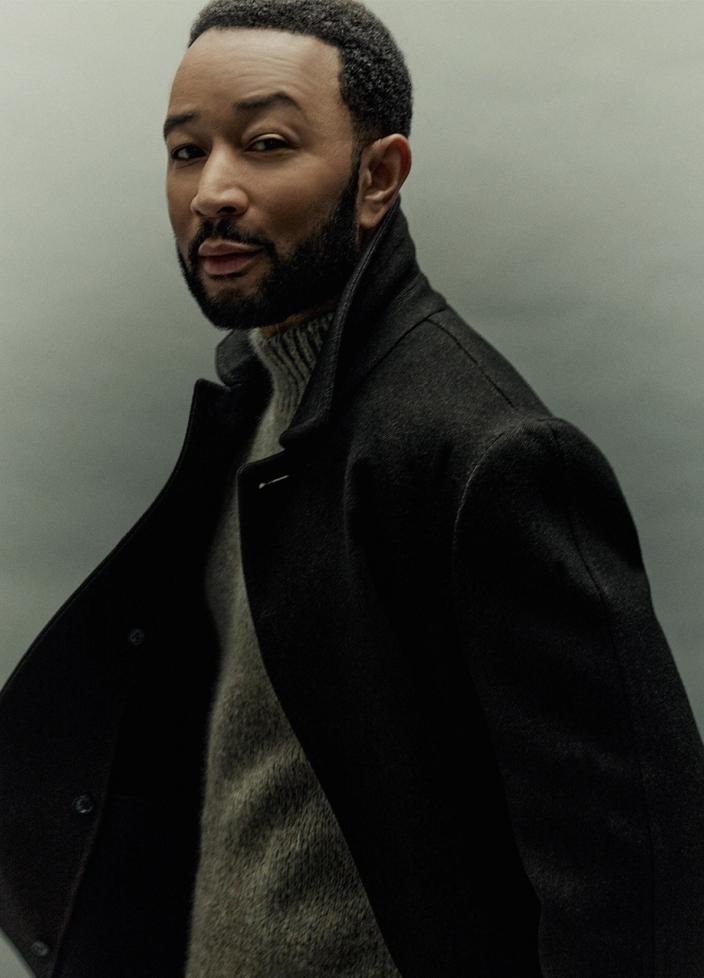
Coat and jumper by Brioni.
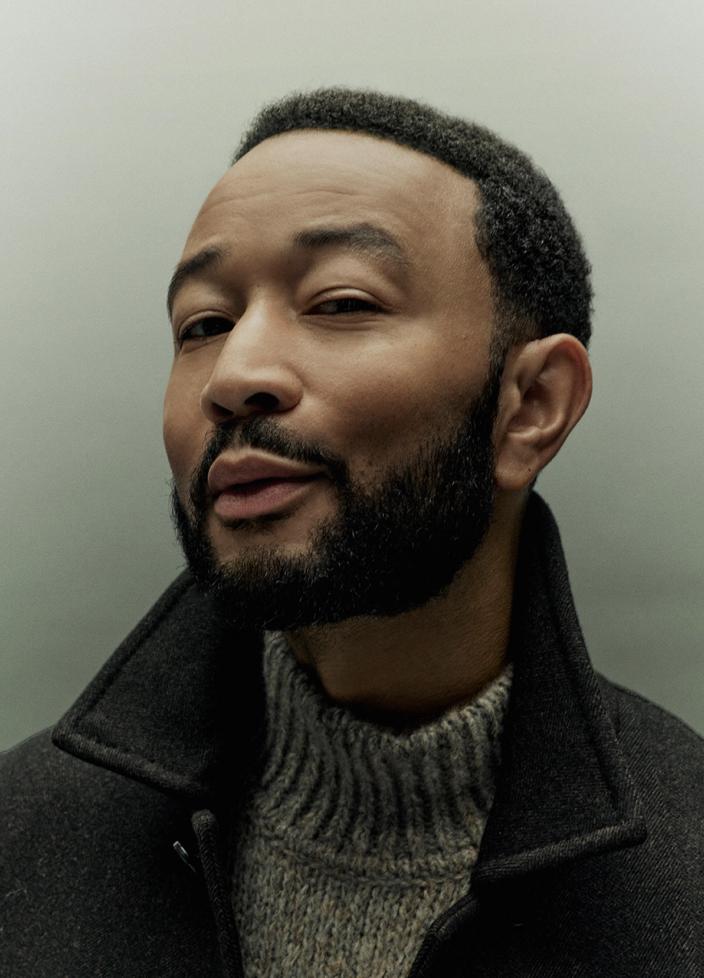
But if breaking through was a challenge back then, Legend believes that today's emerging musicians face an even more arduous journey. “I mean, how do you stand out?” he asks. “Everybody can self-distribute now. Everybody can record themselves at home on their laptop. And that’s great, but it means there’s not a lot of barriers to entry, which means that it’s a wide-open field. And how do you stand out in a wide-open field?”
Music videos, too, he says, have been caught in the digital crossfire. “There’s less money in them these days. Labels just don’t invest like they used to, because there’s no main outlet. There’s no MTV.” Not that this stopped Legend. For Muse, he and Williams enlisted music video veteran Paul Hunter to give the tracks their own visual identity. His favourite is the video for ‘Fireflies’. “I love it. The way it goes back and forth between black and white. A lot of that was Pharrell’s vision early on. He had this vision of me at an upright piano, in front of a brigade of musicians.”
“How do you stand out in a wide-open field?”
Brigade is right. Think trombones, trumpets, double basses and drum machines. That upright piano, too, reminded Legend of home. “My old, beat-up, out-of-tune piano growing up in Ohio. It was part of our family.” That reverence for the past runs deeper still in ‘Fireflies’, which pays homage to his musical forefathers — and foremothers. “It sort of chokes me up when I listen to it,” says Legend. “Thinking about my ancestors, and how influential my grandmother in particular was in my life as a musician. She never lived to see this happen for me, and the idea of how my life is a manifestation of her wildest dreams? That’s pretty cool.”
There's even a pleasing bit of poetry Homer himself would admire. “Clay” pairs with “pain”, “dark” with “divine spark”. “I love that section,” says Legend. “With the rhymes. That’s for my ancestors.” This sense of musical inheritance runs through the whole album, whether in the rollicking, gospel-tinged ‘Pray For Ya’ or the old Hollywood, wedding reception-ready ‘Her’, which features Williams himself. “Pharrell wanted to create something with all of these classic, cinematic elements,” says Legend of the track. “A Black James Bond aesthetic.”
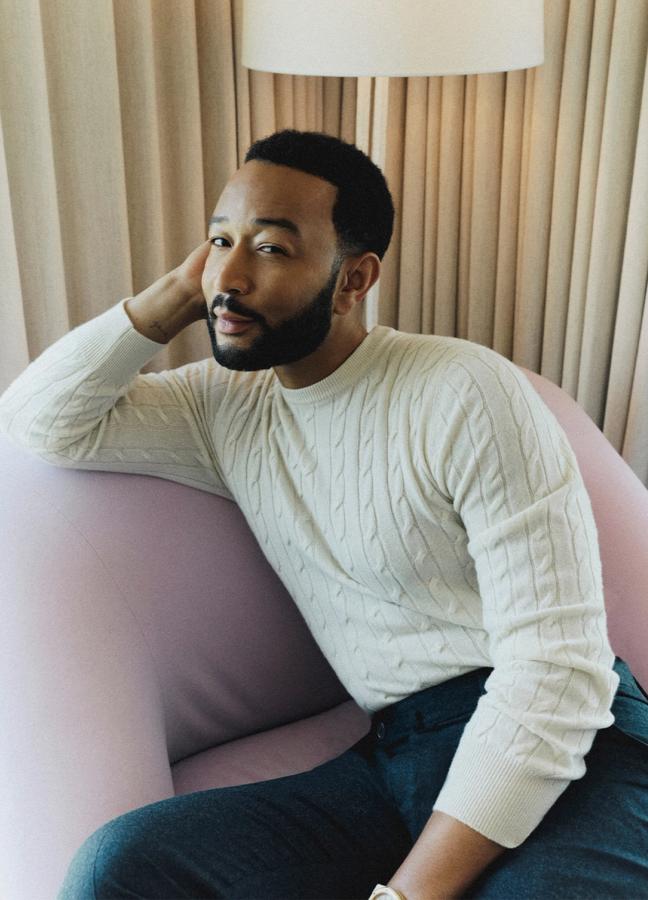
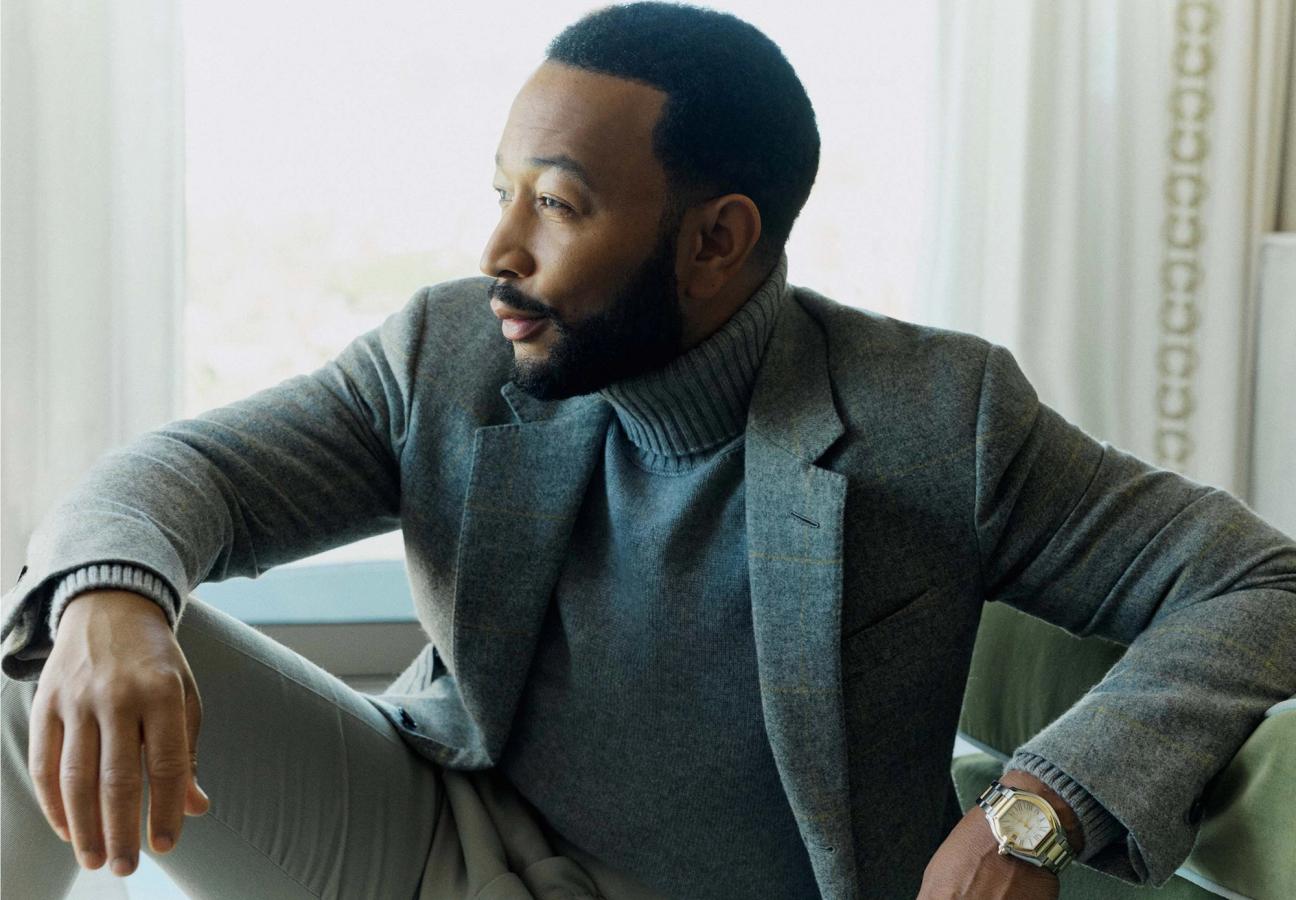
Jumper and trousers by Luca Faloni.
As it happens, the day we're speaking, the final contenders for the new 007 are undergoing their not-so-secret screen tests somewhere in London. And while Legend says he doesn't have a “rooting interest” in who they pick — “I've met Dua Lipa's husband [Callum Turner] and he seems like he could do it. He's definitely talented, and has the look” — he'd certainly answer the call for a Bond theme.
“Oh, I would love to do a James Bond theme,” he says. “I think it’s such a cool thing to do, and they’ve been responsible for some of the great film music. That aesthetic was definitely one of the things we thought about when we made Muse. We were explicit about it in our conversations leading into the album. Not that we were actively auditioning for a chance to write music for the next [Bond] film!”
Of course, if Callum Turner does score the keys to the Aston, surely Dua Lipa herself would be a shoo-in for the theme. “That’s fine!” Legend laughs. “I’m not starving for more work!” The understatement of understatements. There’s the new album, of course, the upcoming film — and the small matter of two Broadway shows. Legend won his Tony for producing a play, but says: “I’d love to get one, eventually, for a musical that I’ve written.” First up is Imitation of Life, an adaptation of Fannie Hurst's 1933 novel about race and class, followed by Boom for Real, a musical tracing the life and rise of artist Jean-Michel Basquiat.
It's yet another string to Legend's bow, and another medium through which to tell a story. Which brings us, in a suitably circuitous way, back to The Odyssey, a tale Nolan also said “truly contains all stories”. So what's the story Legend is telling with Muse? “That of an artist,” he says. “An artist and their muse, through the twists and turns in their own relationship, from attraction to infatuation, to romance, to betrayal, to reconciliation, to betrayal again. And then? Revenge.”
Doesn't get much more mythic than that.
Want more cover interviews? Jeremy Irvine talks Spielberg, party-crashing and being ghosted by Pierce Brosnan…
Become a Gentleman’s Journal member. Learn more here.