The art of letting go: freediving with Arnaud Jerald
A breathless encounter off Cap Ferrat with ten-time world-record freediver Arnaud Jerald — and the Richard Mille mechanical tool he trusts when every second counts.
- Words by: Archie Rutland
- Photography: Lloyd Images, Daan Verhoeven & Charlotte Benoit
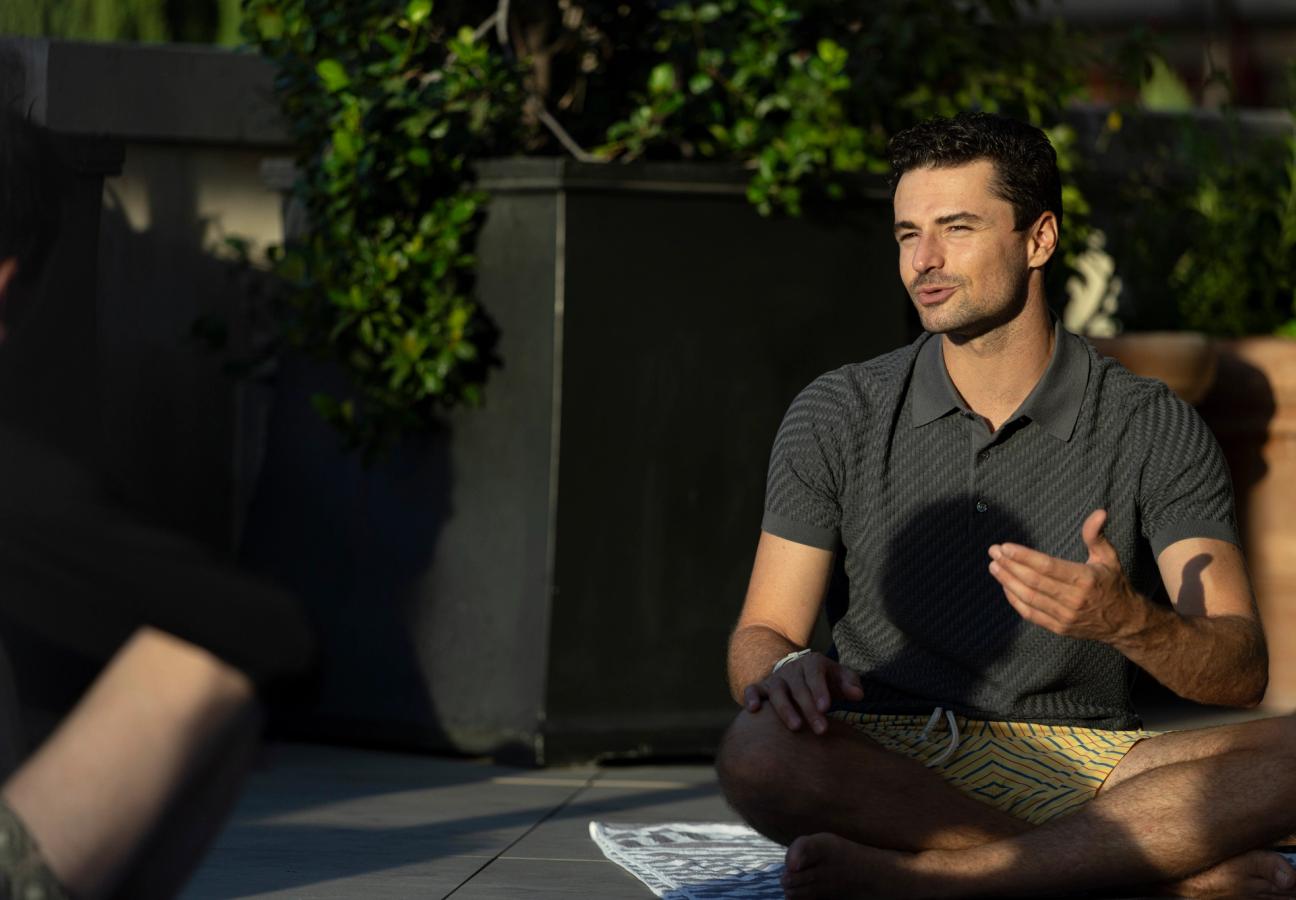
Facing up at a clear blue sky, we both draw in a final breath. Cool water laps gently at our floating bodies as the warm Riviera air fills our lungs until they expand no more. Synchronised, we roll over and pause for a moment, face down in the water. A sense of apprehensive calm washes over my body as life above water fades into the background. A rocky outcrop ten metres below us partially obscures the inky blue water beyond.
Ducking down and raising our feet to the sky, we begin our descent. Arrow-like and completely inverted, our streamlined bodies quietly slip away beneath the surface. Mindful not to work too hard, our fins propel us downwards. With each metre, the growing pressure squeezes our bodies, gradually compressing our lungs to a fraction of what they were at the surface. Passing the point of neutral buoyancy, gravity takes over and starts to draw us down. Finning becomes unnecessary as the blades on our feet barely flutter in our slipstreams. The occasional kick to maintain momentum is all that’s needed.
Disappearing from view, we glide past the rocky outcrop as if wingsuiting over a steep canyon. This is what freedivers refer to as freefall. For many, it’s the sensation that keeps them coming back. Letting go of tension, this is where relaxation and acceptance become non-negotiable. An unsettled mind raises the heart rate and burns precious oxygen. A missed equalisation can cost you the dive.
The person gliding next to me knows this only too well. At thirty, Richard Mille partner Arnaud Jerald is already one of the most accomplished professional freedivers in the world. The waters beside Saint-Jean-Cap-Ferrat are where he trains for competitions and world records — of which he already has ten. The bay’s seemingly innocent waters conceal one of the deepest natural harbours along the coast, reaching close to 100m just a stone’s throw from shore. It is an ideal location for freediving, sheltered from prevailing winds and choppy seas.
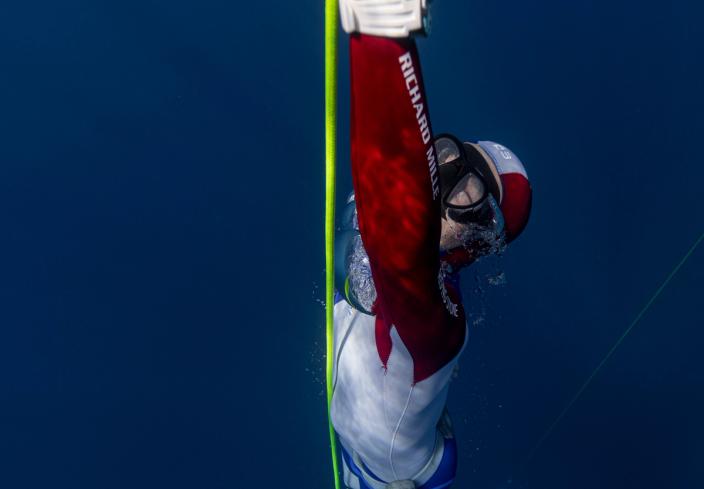
Beneath the calm waters off Saint-Jean-Cap-Ferrat. Image credit: Lloyd Images.
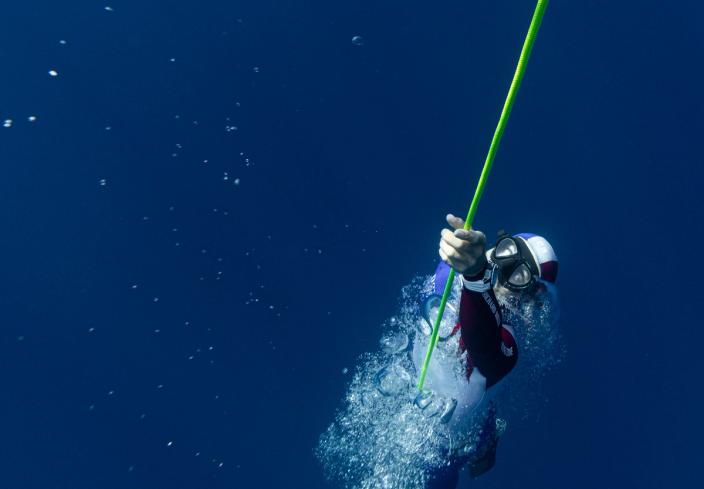
Jerald grew up in Marseille. His father was a keen spearfisherman, and that’s where his love of the underwater world began. It’s a place you can go to truly shut off from the outside, where your mind doesn’t wander in search of tasks or stimulation.
“I never excelled at my academic studies, all I wanted to do was things like cooking and be in nature. The little things in life become insignificant. Being underwater gives me a feeling of serenity, where minutes feel like days above the surface.”
Having discovered his unusual talent at a young age, Jerald is still the youngest freediver to have officially reached 100m, when he was 21 years old. He set his first official world record of 108m aged 23. His latest world-record dive was 126m using carbon-fibre bifins. He performed that dive last year at Vertical Blue 2025, held at Dean’s Blue Hole, a cavernous 203-metre-deep marine sinkhole on Long Island in the Bahamas. That depth has since been surpassed by just three metres by Russian freediver Alexey Molchanov — showing both how narrow the margins are at the top and how relentlessly the limits of human performance continue to be pushed.
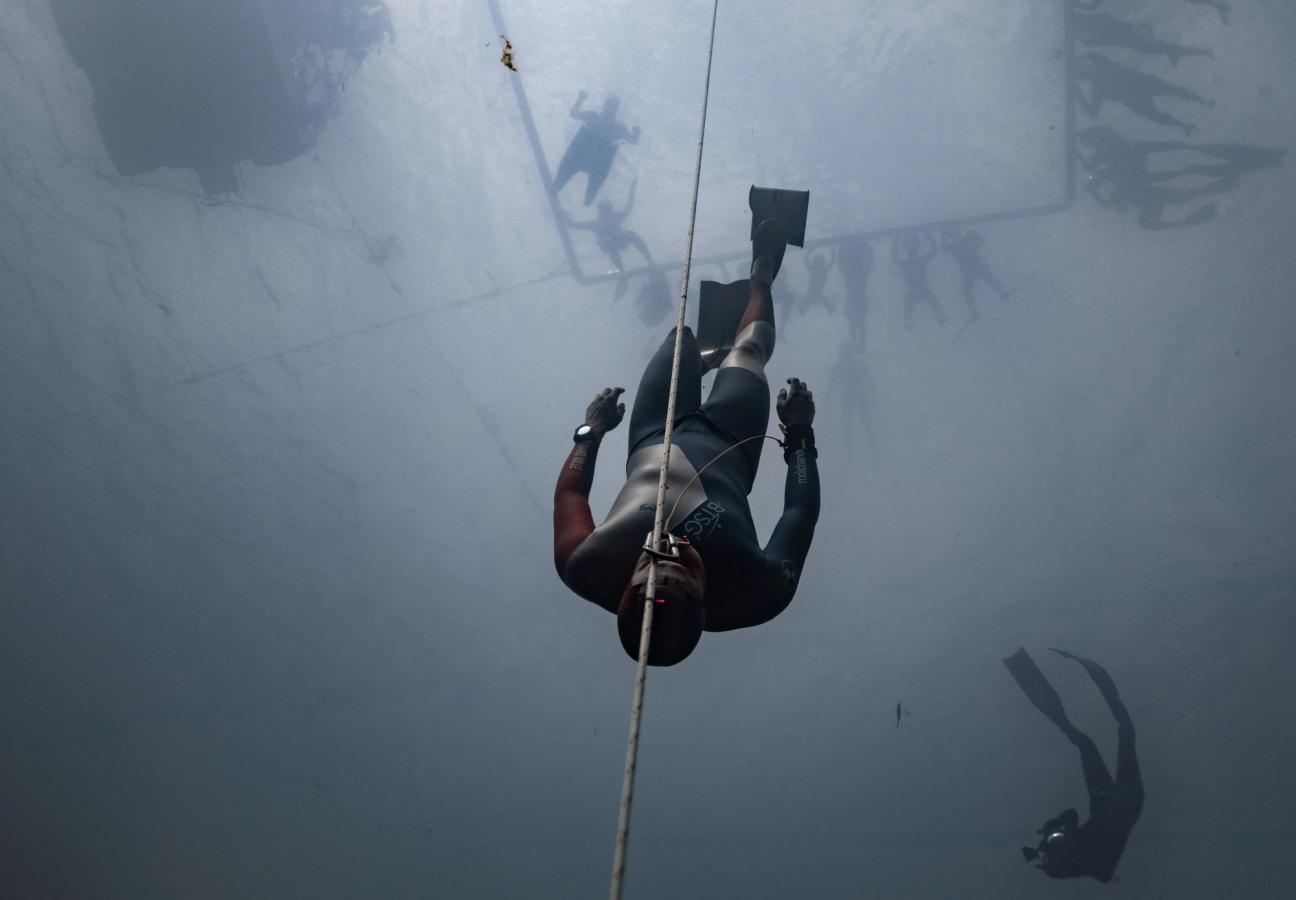
Descending into Dean’s Blue Hole. Image credit: Daan Verhoeven.
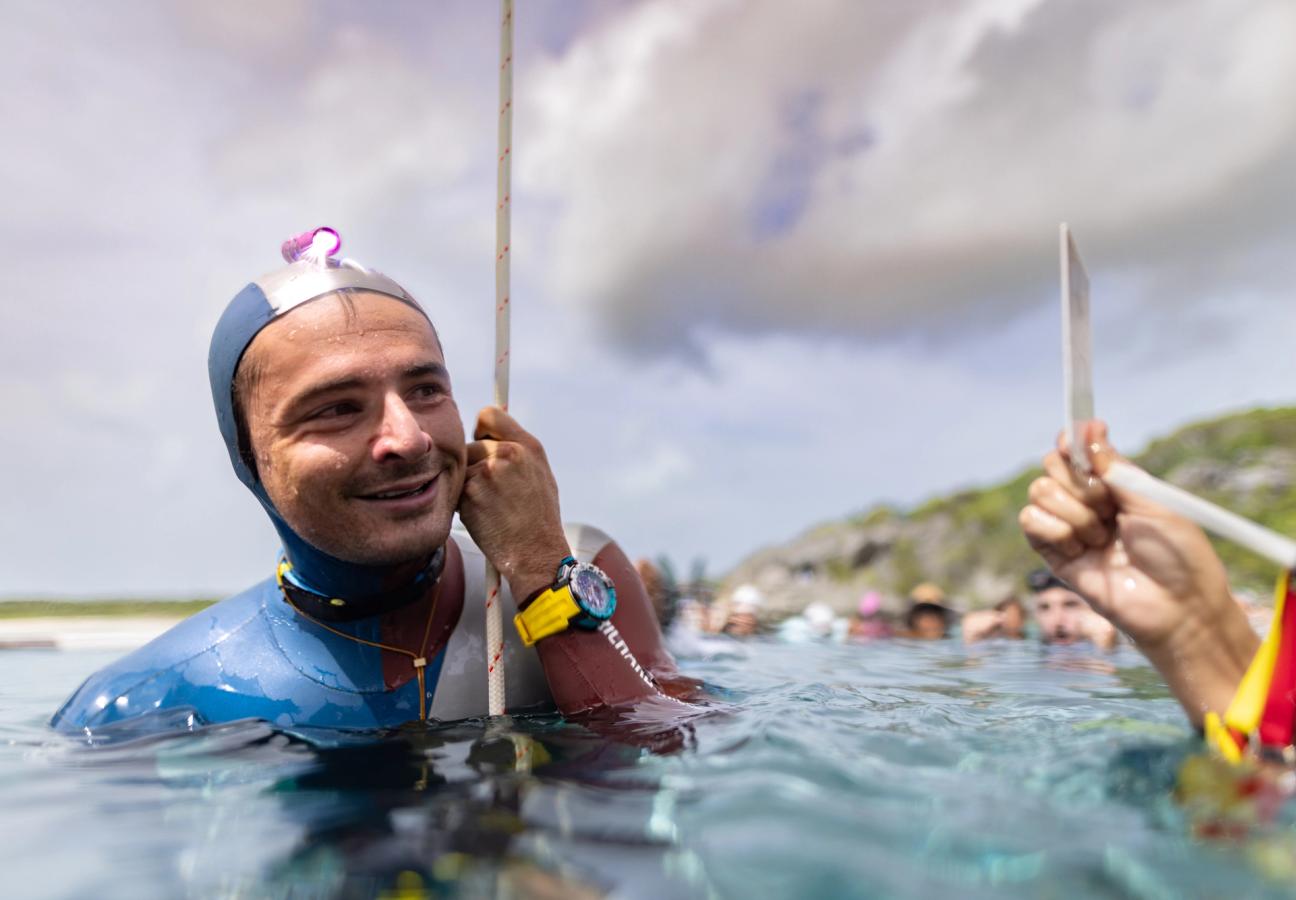
Jerald being shown the white card after a successful 122m dive and his eighth world record in CWTB at Vertical Blue 2023. Image credit: Daan Verhoeven.
Freediving is not about turning up and seeing how far you can go; there is precision in every detail. Official Top times follow a strict schedule, and mistiming the start by even seconds can result in a penalty or disqualification. The end of the rope is set to an exact depth, declared the day before a competitive dive. From waking and hydrating to stretching, putting on the wetsuit and entering the water, every detail of a warm-up routine is meticulously planned — a little like a Swiss train schedule.
Yet for all the numbers surrounding the sport, Jerald is careful not to become consumed by them. His training reflects that same restraint. At times, he will take three rest days for every day spent training, preferring to arrive in the water fully recovered rather than force progress. He tells me he has never experienced a blackout — and says he is the only professional freediver to have reached 100m without ever suffering one.
Perhaps it is fitting, then, that he chooses a mechanical chronograph over a digital watch. Rather than focusing on an ever-deeper number on a screen, his attention is drawn to time, preparation and how the dive feels.
That philosophy also shaped the partnerships he was willing to accept. After proving himself beyond the 100m mark, Jerald did not accept the first few offers of sponsorship that came his way.
“Something did not feel right, I could feel the pressure from the brands to perform in the water, which is counterproductive in this sport.”
In 2016, Jerald saw French businessman and racing driver François Perrodo wearing a watch by Richard Mille, a brand he had never heard of before. Not knowing what it was may have been why he was so drawn to it.
Only a week after seeing him interviewed on French television, Amanda Mille, Brand & Partnerships Director for Richard Mille, received an email from the French freediver. Astonished by the coincidence, she arranged to meet with him. That meeting marked the beginning of a partnership that continues today, with Jerald representing the brand at competitions across the globe.
Jerald wears an RM 032 Automatic Flyback Chronograph, which he refers to not simply as a watch, but as a tool.
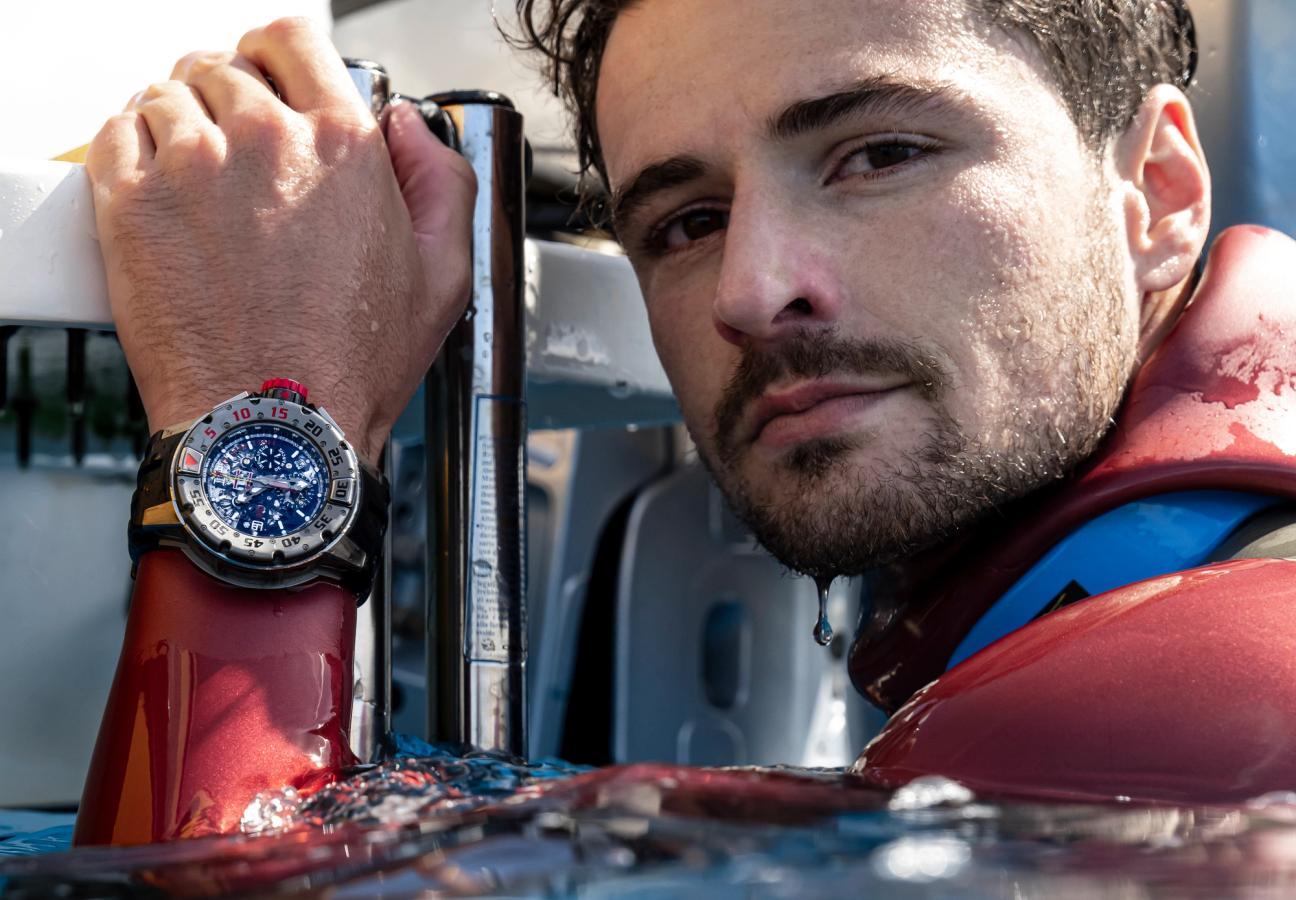
The RM 032 Automatic Flyback Chronograph worn by Arnaud Jerald. Image credit: Charlotte Benoit
“We weren’t looking for a freediver but it just felt right. It was the perfect way to continue testing our watches in extreme environments.” - Amanda Mille
A mechanical chronograph is an unusual piece of kit for a freediver because it doesn’t tell you how deep you went. For Jerald, its value is in the preparation. Eyes closed, holding his breath, he visualises his entire dive from start to finish. Despite not looking at his watch once, when he opens his eyes and takes a breath, almost exactly three minutes and forty-five seconds have gone by - the same dive time as his 126m world record.
“Our relationship with Arnaud goes well beyond the title of "ambassador". It’s a true partnership. We’re invested in his success, we feel the weight of what he does, and we’re with him every step of the way.” - Amanda Mille.
Back beneath the surface, watching him glide effortlessly along the seabed, with little more than fins and a wetsuit, it’s striking how peaceful and comfortable he feels down here. Despite all the precision in the preparation, once a dive begins, it really does all come down to a feeling. As the urge to breathe grows stronger, I turn towards the surface, kicking firmly against gravity but conscious not to rush back. The sunlight brightens and the water grows warmer. Eventually buoyancy takes over again and for the last couple of metres we float towards the surface.
And breathe.
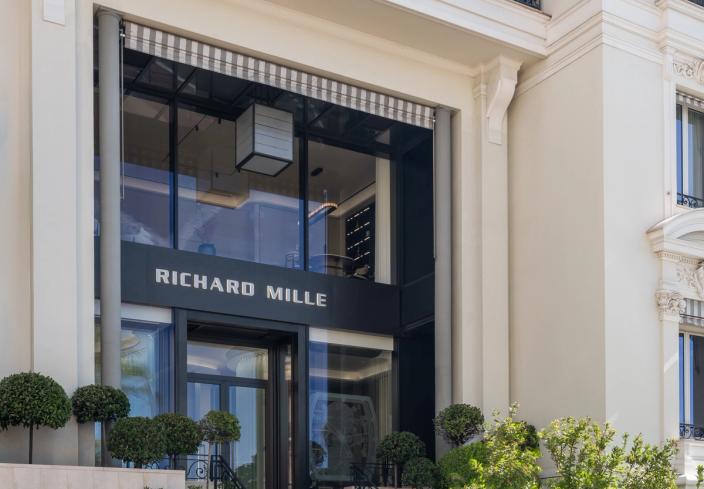
Back at the Monaco Yacht Show, I look out from Richard Mille’s new boutique at the vast superyachts towering above the harbour walls. Champagne, fashion, smartphones and extravagance in every direction. It feels a world away from the place we just left, where none of it matters. Yet in a corner of the globe where almost anything can be bought, perhaps that is the curious appeal of freediving: one of life’s greatest luxuries is the ability to shut everything else out and simply let go.
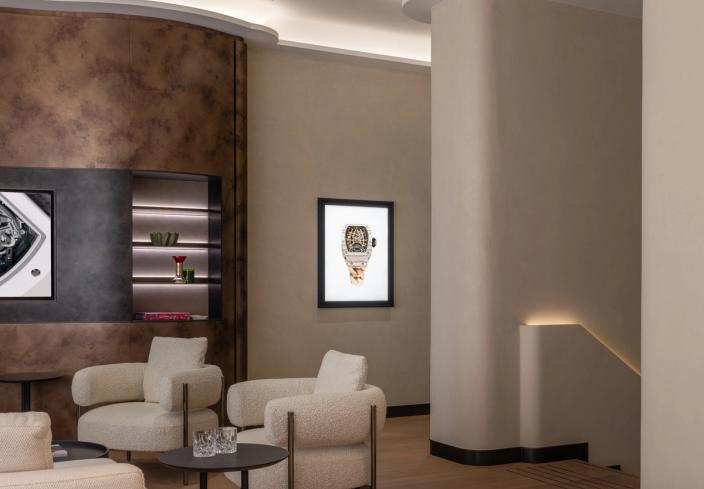
Richard Mille’s new flagship store on Avenue Princesse Alice in Monaco.