Property -- 3 days ago

Whether a golf simulator improves your game comes down to how deliberately you use it. With steady feedback and structure, it can turn casual practice into meaningful progress.
At some point, usually during the third sideways tee shot of the afternoon or the fourth washed-out Saturday of winter, a seductive idea appears. Perhaps salvation lies not in more time at the range, but in a glowing rectangle at home that claims to know precisely what your golf ball is doing and why.
The brochure promises tour-level data, Pebble Beach in your garage, and a swing reborn in glorious high definition. The question is more practical. Does all this technology turn into lower scores on an actual, slightly scruffy golf course, or is it merely an elaborate way of confirming your existing incompetence with graphs?.
Look closely, and the answer is more interesting than either fantasy or cynicism allows. A good golf simulator is not a toy. It is a small, exacting department of golf affairs. Treat it properly, and it can change your game. Treat it as a very pretty arcade, and it will simply document your bad habits in 4K.
Traditional practice is based largely on vibes. You hit a ball into the middle distance, decide the wind interfered, and reassure yourself that the eight iron is definitely a 150-yard club because once, in 2019, it went that far with a following gale and downhill lie.
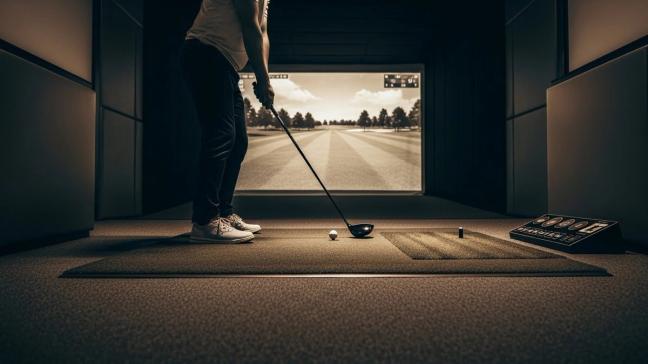
A DIY golf simulator dispenses with this polite self-deception. Every swing is reduced to numbers and flight. Ball speed, launch angle, spin, club path, face angle, carry distance, dispersion. It does not care how majestic the swing felt. It reports only what occurred.
This is uncomfortable. You discover that your gentle fade is a persistent slice, that your “stock” seven iron varies by two clubs, and that impact is occurring rather more towards the hosel than anyone would publicly admit.
Yet this brutality is precisely the point. Once you know, with boring certainty, what the club is doing, you can attempt to change it and see whether the numbers agree. Move the ball back and watch how launch and spin behave differently. Shorten the backswing and observe the dispersion narrow. Work with a coach, and you can test each adjustment in real time instead of waiting half a season for the scorecard to render a verdict.
The simulator does not possess magic. It simply replaces guesswork with evidence. Improvement follows if you are prepared to make peace with that evidence.
Golf is famously high maintenance. It insists on daylight, half a day off, cooperative weather and the availability of a patch of land large enough to inconvenience nearby farmers.
An indoor setup shrinks those demands to something human. Practice becomes an activity you can undertake at six in the morning or nine at night, in odd corners of the week that would never stretch to a full trip to the course. Twenty minutes of wedges before work. Half an hour of driving after dinner.
Frequency is where the simulator quietly wins. Instead of a heroic session once a fortnight and long fallow periods in between, you can work on one part of the game several times a week. Golf responds well to this sort of modest, sustained attention.
Efficiency improves as well. An hour indoors contains more actual golf than an hour outside. No walking between shots, no hunting in rough, no waiting for the group in front to discover that they are not, in fact, eligible for a ruling from Dubai. You hit, observe, adjust. Less trudging, more learning.
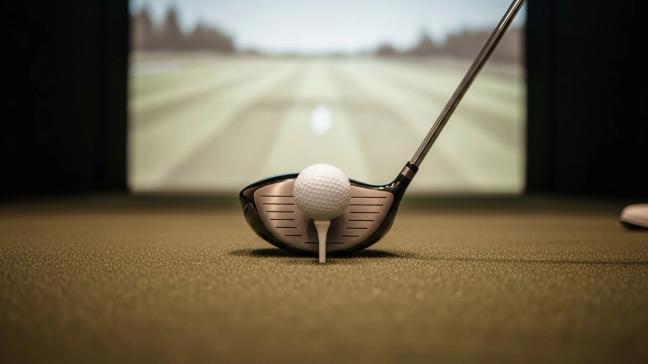
The obvious suspicion is that proficiency indoors may bear only a passing resemblance to competence outside. It is one thing to stripe drives into a screen; quite another to find the fairway when there is actual trouble left and right and a breeze that refuses to cooperate.
The truth is mixed, but encouraging. Full swing patterns transfer remarkably well. If you learn to start the ball on line, reduce curvature and strike the middle of the face under the polite conditions of an enclosure, those skills accompany you to the first tee. Physics refuses to distinguish between ball flights indoors and out.
Distance control, especially with wedges and middle irons, can also improve markedly. After a few sessions of hitting to specific yardages and seeing carry numbers, you know how far a smooth three-quarter shot genuinely travels. Club selection becomes less theatrical and more professional.
Where the simulator is less authoritative is in the messy charm of real golf. Uneven lies, wet rough, hard links turf, awkward stances, wind that changes its mind during your backswing, bunkers, nervy chips to slick greens. These require outdoor rehearsal. Indoor putting, meanwhile, is usually an approximation dressed in pixels.
Used wisely, the simulator handles the mechanics and the statistics. The course then adds texture and mischief. Ignore one or the other, and your game will show it.
It is easy to forget that a golf swing is physical work until your back complains after the first round of spring. An hour on a simulator is a quiet reminder. Swing, reset, swing again. Muscles, joints and balance are all recruited in a way that no amount of wistful putting in the hallway can replicate.
Regular indoor sessions keep the golfing parts of the body awake. Hips coil, shoulders turn, core stabilises, feet learn to stay interested through impact. For anyone who spends the working week folded over a laptop, this alone is a public service.
For older players or those returning from injury, the controlled environment is especially useful. You can limit the session length, choose forgiving clubs, focus on tempo rather than speed and build confidence gradually. There is no need to trudge six miles while wondering whether the hamstring will give out on the 14th.
A simulator does not replace general fitness, but it does mean that, when the season begins, your swing feels practised rather than experimental. That is nothing.
The mental side of golf occupies far more space than most of us like to admit. Certain holes acquire mythic terror. Certain swings feel cursed. The first tee can resemble a public inquest.
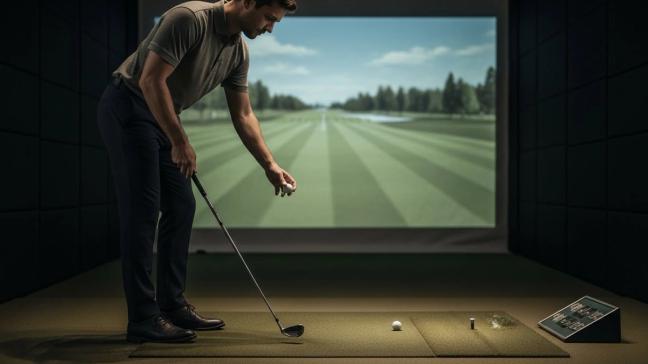
Indoors, the drama recedes. You can fail privately and repeatedly. You can explore a completely different grip or swing thought without wondering what the group behind is thinking. You can hit twenty balls into a simulated lake while trying to fix a move, and no one will sigh pointedly.
The simulator also documents improvement in a way brains rarely do. We tend to remember disasters and discount quiet progress. Numbers tell a different story. Dispersion shrinks, spin rates stabilise, and that ghastly push begins to visit less frequently. Even when scores on the course lag behind, you have objective proof that something is moving in the right direction.
On a more cheerful note, there is simple fun. Playing famous courses you would otherwise only see on television, competing in silly challenge modes with friends, watching each other attempt hero shots without the risk of actual water, all keep you attached to the game in months when you might otherwise sulk indoors and forget why you picked up a club in the first place.
Not everyone needs a digital practice suite in their life. Certain categories of golfer, however, are unnervingly well suited to it.
The time-poor but serious player with work, family and ambitions for a respectable handicap will find that short, frequent, structured sessions indoors do more for their game than the occasional heroic pilgrimage to the range. The simulator lets them behave like a tour professional for half an hour before school drop off, which is more useful than it sounds.
The data inclined improver is another obvious winner. If you are the sort of person who secretly enjoys spreadsheets, dispersion charts and marginal gains, the constant stream of information will feel like a gift rather than a lecture. Applied sensibly, it accelerates change.
Beginners and returners also benefit, provided they are not left entirely to their own devices. Learning basic grip, stance and motion without the pressure of an audience is pleasant. The risk, of course, is perfecting a dreadful move, so some form of coaching, live or remote, is sensible insurance.
Those who merely like the idea of golf but have no intention of practising intelligently may find an indoor bay entertaining, but not transformative. The simulator cannot provide discipline. It can only reward it.
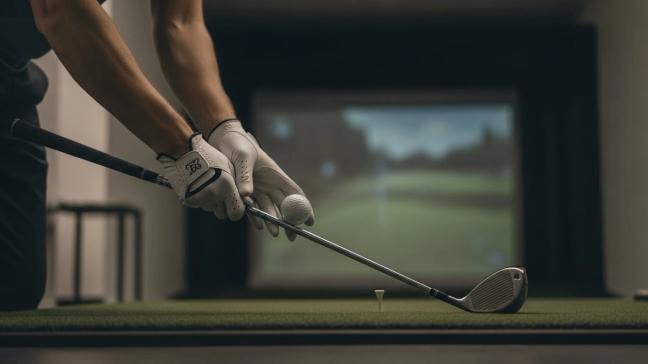
So does this glowing shrine in the corner of the room actually make you better? The honest answer is that it can, and often does, for those who use it properly.
If you approach it as a practice facility rather than a novelty, work on specific aspects of your swing, pay attention to the data and still make time for real grass and real greens, then the improvement in ball striking, distance control and confidence can be striking. You will return to the course less rusty, more informed and rather more likely to believe that you belong there.
If, however, you simply thrash drivers at virtual par fives in between checking your phone, you will become excellent at thrashing drivers at virtual par fives in between checking your phone. The handicap will remain unmoved.
A simulator is not a miracle. It is a mirror with very good lighting. It shows you what you are actually doing, patiently and without flattery, and gives you endless chances to do it better. For a game built on tiny margins and elaborate self-delusion, that is a quietly powerful thing.
To receive the latest in style, watches, cars and luxury news, plus receive great offers from the world’s greatest brands every Friday.