

Culture -- 22 days ago

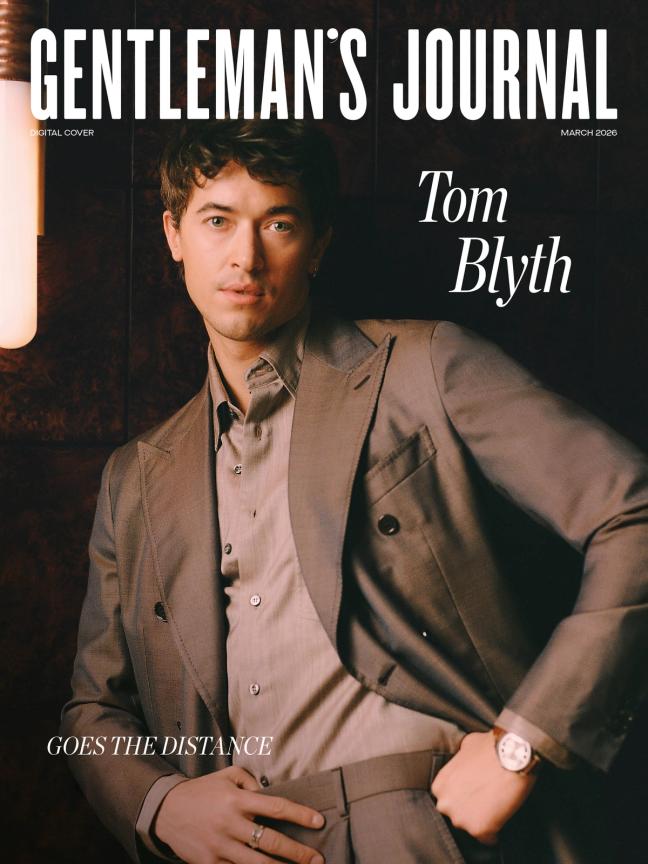
From blockbuster franchises to bare-knuckle dramas, the fast-rising British actor is fuelled by risk, reinvention and refusing to play it safe. At The Newman Hotel, he talks us through his hard-hitting process…
Ding, ding! And he steps into the ring! Although, sadly, Tom Blyth hasn’t played a boxer. He might never, but that would be a crying shame, because he’d probably really throw himself into it. Maybe he’d even keep it up. Naturally, that would mean picking a nickname. ‘Bruise ‘Em Up’ Blyth would do it. Tom ‘The Bomb’ Blyth? Even better. But my pick? ‘Brave’ Tom Blyth.
Why? Because I’ve been interviewing actors for more than a decade now, and I’ve never before seen someone take on so many roles — and come out so fearlessly and fiercely swinging — so early on in their career.
Blyth’s two big breaks came post-pandemic — within just a year of each other: a young President Coriolanus Snow in The Hunger Games: The Ballad of Songbirds and Snakes on the big screen, Billy the Kid for three boot-scootin’ seasons on the small. Since then, it’s been one knockout after another. Undercover cop? Check. Hard-edged inmate? Naturally. Investment banker? Two. Schoolteacher, construction worker…you get the idea; each role a complete transformation.

Ralph Lauren Purple Label Linen Shirt, £660, Cashmere Silk Tie, £270
But this isn’t relentless reinvention for the sake of it, says Blyth. It’s about commitment. Currently enduring a few weeks of London drizzle before jetting to Los Angeles, he explains: “For a performance to be good, you have to care enough about the stakes. And the stakes have to be really high. Even if it’s a calm kitchen-sink conversation, the stakes still matter.”
There’s little calm about Blyth’s most recent role, as pugnacious young offender Dee in Wasteman. And the prison drama — a toothbrush-sharp two-hander with Industry’s David Jonsson — punches up more than just the performances. Directed by first-time filmmaker Cal McMau, its first frames are shot vertically on an iPhone, and the story increasingly plays with aspect ratios and filming styles as it simmers on. It’s ruthlessly effective, and, like Blyth’s previous film, the 1990s-set Plainclothes, which made use of grainy VHS-style sequences, technically risky.
“I think I’m drawn to stuff that is, at least, trying to be brave,” says Blyth of this unconventional filmmaking. “Or trying to do something different — to take risks, and risk being messy. Because when you start playing with the form, it can go wrong. But it can also have a massive pay-off. When you risk the mess, or something that’s never been done before, you also risk finding truth that hasn’t been found before.”
See? Brave. And it’s an approach he also applies to the acting part of the cinematic equation. Not that he’d use that word. Like most actors, Blyth is staunchly against the ones and the zeros — the algorithms and automated AI filmmaking that are threatening to creep into his craft. Although, true to form, he’s not as scared about it as some. “It’ll never surpass what we do,” he shrugs, “because we all love to watch the messy reality of what it’s actually like to be a person. You could go on ChatGPT and watch your own movie, but it’s completely fake. You won’t feel anything.”
And feeling? That’s Blyth’s daily bread. His raison d’être. Forget the contact lenses, the wigs — his real passion lies in becoming these characters from the inside out. “I’m always trying to do some sort of transformation,” he says, “whether it’s Billy the Kid, with the accent, the gait, the way he holds himself — or, in The Hunger Games, playing Snow’s class and pride into the way he carries himself.”
That’s not to underplay his various physical transformations. In Wasteman, for example, you’ll see Blyth bulked-up (dare we say, a boxer’s build?), with his hair clipped slightly shorter, and tattoos wrapped around his neck. This semi-permanent ink stayed on for a whole month, meaning that, save for one night when Blyth was going to an event (and didn’t want to look like a “wrong ‘un”), the actor literally lived in someone else’s skin.
“I’m always trying to do some sort of transformation…”
“It was definitely different,” he laughs. “I just looked like I had a bit more edge to me than I usually do. There was actually a moment in Sainsbury’s when I got followed around by a security guard. He was subtle, but I could see that he was keeping an eye on me in a way that I don’t usually get. That was interesting.”
Dee speaks in a swaggering, street-smart London accent. It’s closer to Blyth’s own voice than, say, his Billy the Kid drawl, but still a far cry from the tones of his birthplace, Birmingham, or those of Yorkshire, where he lived during his father’s tenure as a producer on Emmerdale. But Blyth has an uncanny ear for accents. Even as a child, he confesses, he was “a massive mimic.”
“If someone was walking past, and talking in an accent I didn’t recognise, I’d try to mimic it. It’s only now, doing what I do for a living, that I realise how valuable that was.” While at drama school — New York’s prestigious Juilliard — Blyth recalls that students were tasked with “bringing in” a new accent every week for a year. “But I just love it,” he adds, “figuring out where different voices are placed in the mouth.”

Paul Smith Dark Navy Linen Trousers, £350, Orange Embossed Belt, £175
This natural curiosity complements Blyth’s bravery. He doesn’t mind letting his characters in, living with them for extended periods. Rather, he’s eager to understand them, to identify mutual talents, twangs or aspirations. For fear of spoilers, we won’t name the films, but Blyth admits he’s “been doing a lot of dying recently.” And, he reveals, this made him “slightly fearful,” because, for once, he had nothing to draw on.
“I had a revelation,” he says. “That this was the one thing I had to emulate that I had no idea about. I have no idea how it feels. I do, however, know what it feels like to be so tired that you can’t keep your eyes open.” He’s also been knocked out a couple of times, says the actor (once by a heavy gate as a child, once after falling off a horse, both good practice for his future boxing exploits). “So I kind of get that feeling of not being able to bring yourself around, too. I suppose you just have to look for comparable feelings — experiences that get close to what you need to do.”
We’ll next see Blyth in The Fence, an adaptation of the stage play Black Battles with Dogs directed by Beau Travail auteur Claire Denis. It’s a remarkably surreal viewing experience, but magnetic nonetheless. Blyth plays the rebellious Cal, champagne-drunk and half-tuxedoed for much of the film’s tight runtime. He adored working with Denis, who he describes, at various times, as both “a poet” and “a bulldog”. “I revere her,” he adds. “As a filmmaker, as a human being. I love her, her films, and I was just along for the ride.”
The film — part-thriller, part-drama, part-indefinable art piece — was shot on location in Senegal, where there is no filmmaking infrastructure. “So it was run-and-gun cowboy filmmaking,” says Blyth, “which I also loved. It really felt as though everyone was getting stuck in. No-one had a big fancy trailer. [Co-star] Mia McKenna-Bruce and I stayed on set in a bare-bones shipping container, and everyone used the same Portaloo. We were all just there for the love of it.”
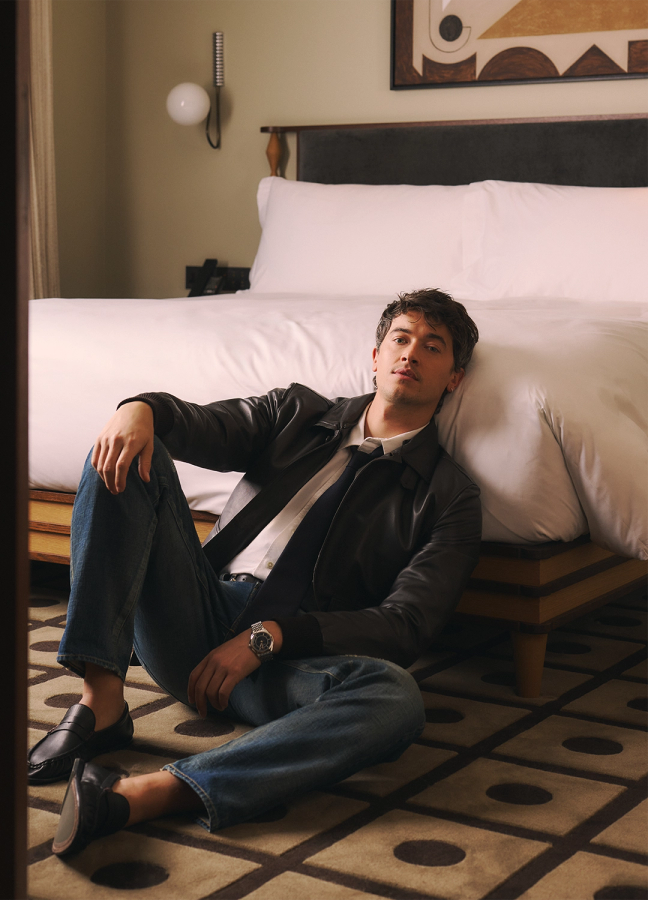
Thom Sweeney Leather Bomber Jacket, £3,995, Cotton Poplin Shirt, £425, Navy Silk Grenadine Tie, £200; Paul Smith Black Leather Loafers, £850; Vacheron Constantin FiftySix Self-Winding 40mm, £15,300; TWC Vintage made to order Jeans
With Africa now added to his resumé, Blyth has shot projects across four continents — Europe, North America, Australia and Africa — despite being barely in his thirties. He’s not slowing down either: he dreams of filming in Japan, and says he’s come close to ticking off Greenland and Antarctica. “To shoot in the snow! I love that idea — I’d love to film in extreme weather.”
If you think he’s effusive about climate conditions, just wait until Blyth begins talking up his co-stars. Alex Hassell, of Rivals fame, is almost unrecognisable in Wasteman, as a viperous fellow inmate. “He’s one of the best who’s doing it,” says Blyth. “Hardworking, generous, gracious, but ambitious at the same time — and he runs his own theatre company? He’s doing it for all the right reasons.”
Yet, when it comes to admiration, Blyth reserves the highest praise for Peter Dinklage, with whom he worked on his Hunger Games breakout. “It was the first big thing I’d done,” says the actor, “and I was around all of these greats and legends. But Peter was just so noble. He came in with these really specific choices, and made it look so easy. He was so fluid and dexterous with language — it never felt forced. And he’s so bold, so unashamed of himself, which I loved.”
Blyth’s own performance was also widely praised. “Nuanced and layered,” said Variety. “Subtle yet powerful,” The Guardian observed. “A captivating mix of youthful innocence and emerging menace,” gushed Empire. And his character’s legacy lives on. Though Blyth never met the late Donald Sutherland, who played an older version of his character in the original films, a new actor — the great Ralph Fiennes — will take on the role of President Coriolanus Snow in an upcoming sequel, set for release later this year. This makes Blyth the filling of a very formidable sandwich.
“But I’m definitely at the bottom of that trio!” he laughs. “It’s going to be so interesting to see what Ralph brings to it. He is, and always has been, one of my favourite actors. It’s funny being part of a lineage like that, because obviously none of us have ownership over the character. But, at the same time, you almost feel like you’re in conversation with those other actors.”
Blyth studied Sutherland’s performance after winning the part. “You don’t want to do an impersonation, but you do want to sprinkle some of those seeds in there. I certainly don’t think Ralph will study my performance, but it’ll be interesting if he brings some of Donald to it.”
Since we're on the subject of iconic, passed-along parts — not to mention that trim tuxedo of his in The Fence — this seems as good a time as any to ask Blyth the obligatory 007 question: would TB take on JB? “I think every young male British actor has probably thought, at some point, that it would be an amazing job,” he reasons. “I think you’d be lying if you said you didn’t. But then I think a lot of us have to ask the bigger question, which is: do I want to step into that world? That’s stepping onto some big shoulders, and it affects the rest of your career.”
“Do I want to step into that world?”
What Blyth will admit is that he loves the world of espionage — and that ‘secret agent’ is one occupation he’s yet to play. “So I genuinely want to play a spy, but it doesn’t have to be that spy. I just find them really fascinating — because they’re professional secret-keepers, and you have to have a very particular type of psyche to do that.”
If he chooses to, he’ll learn their wily ways — because that’s Blyth’s favourite part of his own chosen vocation: learning new skills. “I love, for instance, that I now know how to do cowboy stuff,” he says of his time on Billy the Kid. “I can ride. I can rope, just about. I know how to saddle a horse and shoot guns. There are things that I will forever now know how to do just because I did that.”

Paul Smith Collage Print Cotton Shirt, £300, River Collage Print Cotton Tie, £130, Dark Navy Linen Trousers, £350, Orange Embossed Belt, £175; Vacheron Constantin FiftySix Self-Winding 40mm, £15,300
He’s always admired Daniel Day-Lewis for his commitment to the craft, says Blyth, especially when the acting legend taught himself tailoring for the Oscar-winning Phantom Thread. “Getting to play a character who is so specifically well-trained in one thing? And especially when that thing might not be a common, everyday vocation? I would love to do that,” says Blyth. “I love working with my hands, so the idea of getting to play someone who is very skilled at making things appeals to me.”
How about a sport? Could we tempt Blyth into the boxing ring this way? Given that work ethic and those Wasteman shoulders, there’s likely a mean left hook waiting to be coached out of him. “I’m way more interested in playing a sportsman who does a solo sport, I think,” the actor counters. “Something on your own, like climbing or surfing — a sport that’s one human against the elements, rather than human versus human.”
“There’s a surf film I’ve been attached to for a while,” he adds, “which has been in development for a long time. It’s based on a really well-known book, and I really hope one day it gets made.”
We wouldn’t bet against it — or Blyth. Because, whether he’s twisting his tongue around a new accent, shouldering a blockbuster franchise or simply taking his neck tats for a stroll around Sainsbury’s, the actor approaches everything with unflinching dedication. It’s fitting he mentions Day-Lewis, because Blyth strikes me as another of those heavy-hitting, all-or-nothing actors: always up for a challenge, and already as brave as brave can be. Ready for round two? Blyth certainly is. Ding, ding!
Wasteman is in cinemas now.
With thanks to The Newman Hotel, and Lucy Halperin at The Wall Group using Kevin Murphy Hair and Erborian Skin for grooming.
Become a Gentleman’s Journal member. Find out more here.
To receive the latest in style, watches, cars and luxury news, plus receive great offers from the world’s greatest brands every Friday.