
Property -- 4 days ago

Choosing between a launch monitor and a simulator begins with knowing how you like to practise. Some players want pure numbers, while others prefer a setting that mirrors the course itself.
At some point in a golfer’s life, usually just after they have watched their own swing in slow motion and briefly questioned every decision they have ever made, the game stops being about buying another shiny driver and starts being about information. Ball speed, spin, launch angle, club path, face alignment, descent angle, carry versus total. Numbers, in other words, begin to matter as much as feel.
It is usually around this time that the phrase, "launch monitor vs golf simulator" sneaks into the browser history. One sounds like test equipment from an aerospace programme. The other looks, frankly, like a very expensive way to turn a garage into a members’ club. Both promise straighter shots, more distance and a deeper understanding of why your seven iron refuses to behave in public.
They are not the same thing. A launch monitor is essentially a witness: a small box that watches the collision between club and ball, records the physics and delivers a report in numbers that are brutally uninterested in your feelings. A golf simulator takes that data, adds graphics, courses and weather, and builds an entire experience around it, so that “working on your swing” looks suspiciously like playing eighteen holes in your socks. One is analysis. The other is theatre with spreadsheets.
Before you start measuring ceiling height and rehearsing the conversation about why the dining room is suddenly “multi purpose”, it is worth understanding what each of these devices is actually for, what kind of golfer gets the most out of them, and whether the next addition to your game should behave more like a coach with a clipboard or more like a brilliantly persuasive video game that just happens to tell you the truth.
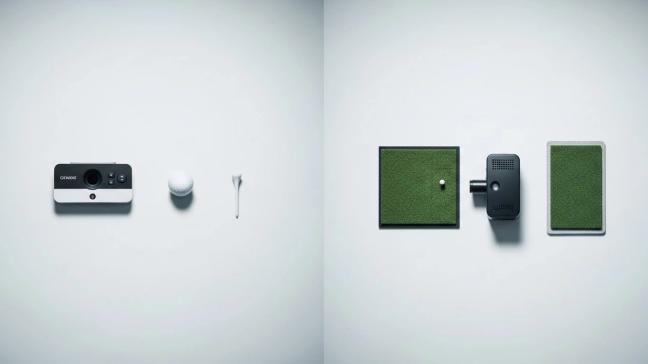
First, a small act of demystification.
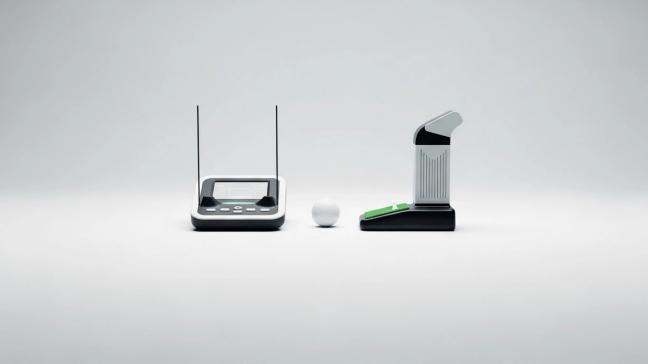
A launch monitor is a measuring device. It sits behind you or beside you, stares at the ball with cameras or radar, and records what happens in the few milliseconds around impact. Ball speed, club speed, launch angle, spin, direction, club path, face angle, all the awkward truths you have been avoiding for years. It cares only about data.
A golf simulator is a stage built around that data. It is the room, the hitting mat, the net or impact screen, the projector or television and the software that turns those numbers into a virtual ball flight on a virtual golf course. In a serious setup, the launch monitor is hiding in plain sight, feeding information into the system while the graphics take the applause.
So every proper simulator contains a launch monitor. A launch monitor, on its own, is simply the brain without the theatre. The distinction is not technical; it is architectural.
Strip away the marketing gloss, and a launch monitor exists for three purposes: truth, tuning and testing.
Truth first. The device tells you, unflinchingly, what the ball and club are doing. That gentle draw you cherish may turn out to be a slice that has been getting lucky. The seven iron you boast carries 160 yards may, in the cold light of data, be a 148-yard trier with delusions of grandeur. The monitor is not interested in your feelings. It is interested in physics.
Tuning comes next. Once you know the numbers, you can attempt to change them. A grip adjustment that feels cataclysmic may alter face angle by a single degree, which, irritatingly, is often enough. Moving ball position, altering swing length and changing tempo can all be observed immediately rather than guessed. This is why coaches and fitters regard these devices as indispensable. They shorten the feedback loop from months to minutes.
Testing is the final gift. Club fitting becomes an evidence-based exercise rather than a contest in who can convince you that you look “more athletic” with a certain shaft. You can see how different heads, lofts or balls alter spin, launch and distance, and choose accordingly. Gapping sessions, where you learn exactly how far each club carries, are suddenly polite arithmetic rather than superstition.
On a range or into a simple net, a launch monitor is ruthlessly effective. You lose the spectacle of seeing the ball land, but gain information that actually changes how you play.
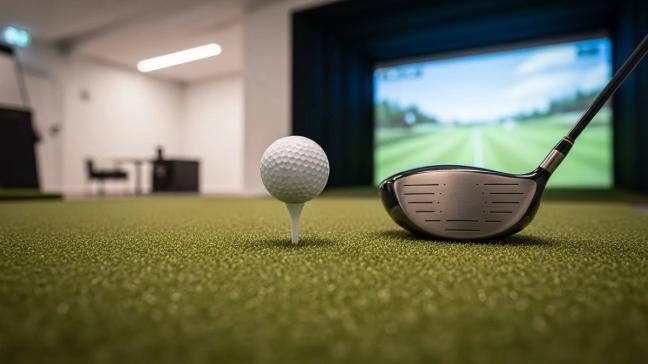
Now to the full theatre.
A golf simulator is what happens when someone decides that numbers alone are not enough and that practice, like everything else, should come with scenery. The core measurement is still provided by the same sort of box, but the experience blossoms.
Instead of looking at graphs on a phone beside a driving bay, you see the ball launching down the 18th at St Andrews or across a digital driving range. Distances, trajectories and penalties for stupidity are all rendered in virtual reality. The room becomes a private golf studio, which is a grander way of saying “a place where you now willingly hit a small white object at a wall”.
The key additions are immersion and context. Immersion, because it feels like golf, not physics homework. Context, because you can see how your swing behaves on actual holes rather than just while sending balls into the middle distance. Club selection, course management and psychological bravado all receive a workout along with the mechanics.
It also turns golf into an indoor social sport. Friends who would blanch at four hours in January wind will happily play nine virtual holes after dinner. Leagues appear. Office tournaments materialise. Somebody insists on attempting a heroic carry over a simulated lake and is rightly mocked when they fail.
In short, the simulator takes the launch monitor’s unromantic data and wraps it in narrative, scenery and mild drama.
There are plenty of situations in which the brain is more useful than the theatre.
If you already spend time at the range, a portable unit is the simplest way to upgrade that effort. You hit balls as you normally would, but now you know what they are actually doing. There is no need for a dedicated room, no need for an impact screen, no need to negotiate with cohabitants about turning the spare bedroom into Augusta.
For those who travel, compact monitors can live in a golf bag. You can take your data to any range, any course, any field that will tolerate your presence. For the teaching professional, this is a roaming studio. For the enthusiastic amateur, it is a private consultant that charges no hourly fee and never raises an eyebrow.
If space at home is limited to a net in the garden or a mat in the garage, a launch monitor plus tablet gives you 90% of the performance benefit at a fraction of the architectural commitment. You lose the cinematic sweep of the ball’s flight, but you gain the ability to practise quietly and repeatedly, which is what your handicap really cares about.
For players who are fascinated by optimisation rather than theatrics, a launch monitor alone is often the rational choice.
There comes a point, however, when the sum of your excuses suggests that you really do need something bigger.
If you live in a country where the weather behaves like an opposition party, oppositional, loud and frequently unhelpful, then a year-round indoor setup can be the difference between maintaining a swing and starting every spring as if you have never seen a club before. The simulator takes “I could not practise” off the table entirely.
If your schedule has been annexed by work, children and the relentless march of life, a dedicated room where golf can be compressed into any spare 45 minutes is an extraordinary luxury. You can play three or four holes of real golf, with real consequences, in less time than it would take to drive to the club and back.
If you enjoy the game as social theatre as much as personal torment, the simulator turns your home into a clubhouse for the weather-averse. Mixed-ability groups can play together without fear of holding anyone up. New golfers can be introduced without the ritual humiliation of their first tee shot travelling six feet.
And, being blunt, if you simply love the idea of stepping into a space where the outside world vanishes, and you are transported to a different course entirely, then the value is emotional as much as practical. Golf is an indulgence; it is allowed to feel like one.
None of this, sadly, is free.
A respectable launch monitor requires a meaningful outlay, though there are now consumer-friendly options that sit well below the sums once reserved for tour professionals. Setup, however, is mercifully simple. Place it in the correct position, pair it with your phone, and you are in business.
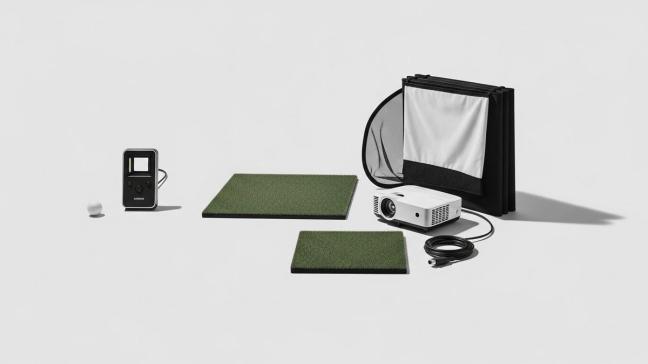
A simulator is a project. You will need sufficient ceiling height, enough width to swing without endangering plasterwork, and enough depth for the ball to fly into a screen without returning at ankle height. You will require an impact screen, framing, netting, a hitting mat, a projector or large television, a computer and more cable management than you would like to admit.
Then there is the small matter of household diplomacy. Announcing that the spare room will now contain a fabric box devoted to the perfection of your six iron may not elicit universal applause. Careful briefing, concessions and, in some cases, shared use of the space for cinema nights will all help secure approval from the relevant authorities.
For many, the sensible route is sequential. Start with the measurement, used at the range or into a net. If you find yourself increasingly drawn to the idea of practising at home and using the device regularly, then promote it to the heart of a dedicated room later.
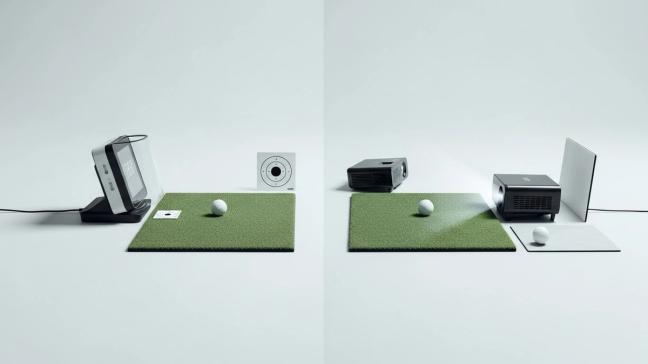
The honest answer is that both can help, but in different ways and in different orders.
A launch monitor, used without a net or on a range, is the purist’s choice. It will improve your understanding of your swing and your equipment, sharpen your distance control and, crucially, hold you accountable. It is hard to ignore a pattern of high-right shots when the data insists on showing you the same face angle every time.
A golf simulator will do all of that if it is built around a proper measuring device, but it will also keep you engaged when conditions or time would otherwise push golf to the margins of your life. You are more likely to practise if the practice is enjoyable, convenient and occasionally ridiculous. Even a well-planned DIY golf simulator can supply that motivation in buckets.
If your goal is purely technical improvement, and you are already disciplined enough to practise regularly, a launch monitor alone may be all you require. If your goal is a mixture of improvement, entertainment and sanity during the winter months, the full simulator begins to look less like extravagance and more like infrastructure.
Before spending anything, be brutally honest with yourself.
If you rarely practise now, and your idea of a productive range session is to hit balls until your hands hurt and then complain about your driver, no machine will save you. A launch monitor will simply reveal how erratic you are in painful detail. A simulator will merely provide weatherproof scenery for the same habits.
If, on the other hand, you are prepared to work, to respond to data, to structure your sessions and still put in some time on real turf for short game and putting, then both tools can accelerate changes that might otherwise take years.
Start with the simplest version that fits your life. A launch monitor and a net can do extraordinary things in the hands of a determined player. If you then find yourself dreaming of a screen, a projector and 18 virtual holes at Royal Birkdale on a Tuesday night in February, you will at least know that the underlying technology is already part of your game.
In the end, the choice is not really between science and spectacle. It is between how much room you can spare, how seriously you intend to practise and how honest you are willing to be with the numbers. The rest is merely interior design.
To receive the latest in style, watches, cars and luxury news, plus receive great offers from the world’s greatest brands every Friday.