Property -- 3 days ago

The benefits of a golf simulator extend far beyond convenience. It turns practice into a private ritual, sharpening technique and rhythm on your own schedule.
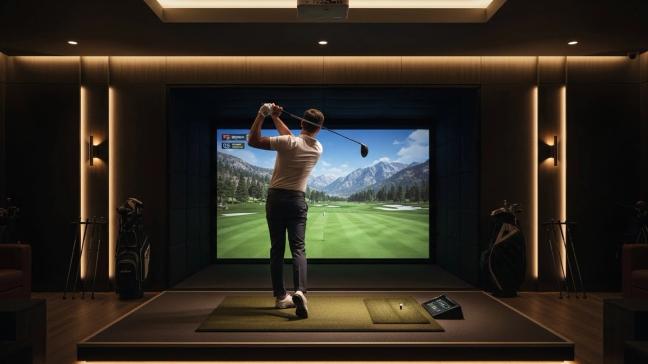
For years, the phrase indoor golf conjured images of a sad little net in a garage and a man in a fleece making contact with the ball roughly one time in three. Then technology improved, launch monitors became clever, software grew glamorous, and suddenly the question was unavoidable. At what point do the supposed golf simulator benefits justify turning part of one’s home into a digital fairway that glows after dark?
Look past the gadgetry, and you discover something interesting. A good simulator is not merely a toy for winter. It is a rather efficient little ministry of golf affairs, quietly reorganising how you practise, how often you swing and, in some cases, how you feel about the game altogether.
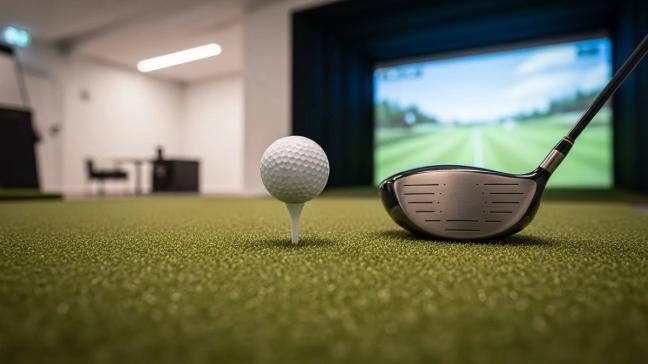
Outdoor practice has a certain romance. You hit a ball, watch it arc into the distance, then draw firm conclusions about what just happened based largely on instinct and misplaced optimism. Was that push actually a push, or did the wind intervene? Did the ball start on line and then drift, or did it leave the club already sulking?
A simulator removes the guesswork. Every shot is interrogated with the enthusiasm of a select committee. Ball speed, launch angle, backspin, sidespin, club path, face angle, strike location, dispersion, carry distance, total distance, and descent angle. Each swing produces a dossier.
This can feel brutal at first. You discover that your beautifully flighted fade is, in fact, an anxious little slice that has been getting away with it in generous crosswinds. You learn that your eight-iron distances vary by a margin large enough to constitute a misunderstanding.
The benefit lies in precision. Instead of beating balls and hoping muscle memory will eventually tidy up the mess, you can work on one variable at a time and see whether it improves the numbers it is supposed to improve. Move the ball position, and watch the spin decrease. Adjust grip, see face angle at impact, and behave more politely.
For wedge play and distance control, the effect is transformative. Ten shots, ten distances, one cold, honest average. Suddenly, the decision to hit a soft nine rather than an earnest wedge is based on evidence rather than vibes. It is uncomfortable, and then it is liberating.
Golf has always demanded a curious mixture of leisure and logistics. A proper round claims half a day, the driving range an evening, both subject to weather, daylight and the operating hours of facilities that close precisely when you finally escape a meeting.
A simulator breaks that tyranny. The course moves in with you.
You can hit half a bucket before breakfast, or play four holes of Augusta at ten at night in January. Short sessions become viable. Twenty minutes of focused practice on a Tuesday morning does more for your game than heroic promises to spend four hours at the range sometime in late spring.
Convenience is not just about frequency; it is about how much of each session is actually spent swinging. In a simulator, whether it’s a DIY setup in your garage or a polished commercial bay, there are no long walks between shots, no searching for balls, no waiting for the group in front to stop consulting the Rules of Golf. Hit, analyse, adjust, repeat. An hour indoors can contain more genuine practice than two hours outside, particularly if your local range has adopted the fashionable policy of never quite having enough mats free.
The result is something golfers rarely experience: practice that fits neatly into life rather than constantly asking life to rearrange itself.
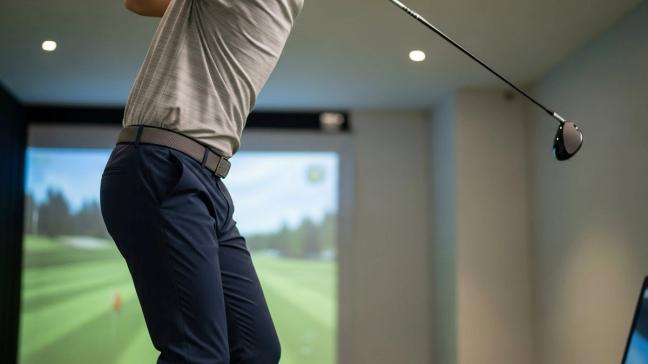
Nobody is claiming that a simulator session is equivalent to walking an undulating championship course with a bag on your back, although your calves may politely disagree the next day. Yet there is a non-trivial physical benefit to swinging in anger regularly.
A full swing recruits muscles from the feet to the shoulders. Repeated for an hour, under control, it becomes low-impact functional training. Balance, coordination and rotational strength are all exercised without the jolts and collisions that accompany more fashionable gym classes.
For older players or those recovering from injury, this controlled environment is particularly valuable. You can hit half swings, three-quarter swings or single clubs at lower intensity while still getting feedback and maintaining patterns. There is no need to clamber in and out of bunkers or tramp through rough. When fatigue appears, sitting down is a matter of moving a few feet rather than waiting for the halfway hut.
As with any form of structured practice, the effect accumulates quietly. A golfer who swings properly three or four times a week, even indoors, is likely to maintain mobility and golf-specific fitness better than one who confines activity to the occasional heroic weekend round.
Golf is famous for occupying far more of the mind than of the calendar. Good shots fade, bad shots linger, and certain holes acquire the kind of mythical status usually reserved for ancient grudges.
A simulator offers a mental reset. It turns practice into a contained, game-like challenge. You can work through a single problem, for example, a chronic over-the-top move, in private, with no one watching. You can revisit a hole that has traumatised you and play it ten different ways, discovering that you do, in fact, possess more than one shot.
Because feedback is immediate and quantified, small improvements are easier to notice. A face-to-path relationship that used to be wildly open becomes only moderately alarming. Dispersion tightens. Three-quarter wedges begin to land in a cluster instead of a postcode. Each tiny gain is recorded, not guessed. Confidence starts to rest on evidence rather than superstitious ritual.
There is also the simple joy of it. A simulator reintroduces a sense of play. You can switch from a serious practice session to a quick tour of St Andrews, or a brisk nine at Pebble Beach in the time it would take to order another drink at the clubhouse. Mistakes provoke laughter rather than a trudge through gorse. Friends who have never set foot on a course will gladly spend an evening in front of a screen, especially if there is food nearby and no dress code in sight.
In a sport that sometimes takes itself sturdily seriously, that injection of lightness is not to be underestimated.
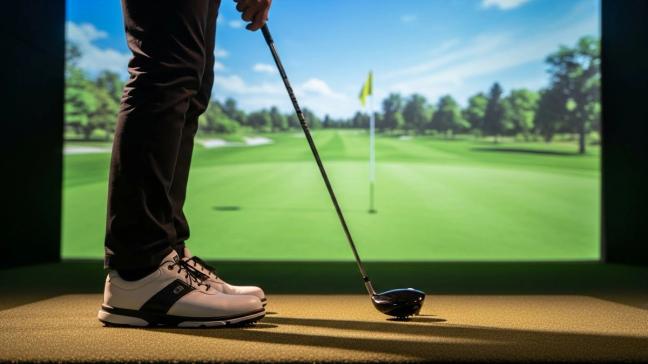
Traditional golf can be terrifically good for the soul, but it is not always welcoming for the newcomer. There are dress codes, rituals, unspoken etiquettes and the occasional member who appears to have been offended by the concept of joy sometime in 1978.
Simulators, by contrast, are delightfully unbothered. They are appearing in city centres, bar complexes, office basements, private homes and places where loud music is considered a feature, not a disciplinary matter.
This shift has consequences. People who live in flats, who work unpredictable hours, who have small children or who simply cannot spare an entire afternoon can now play something that feels like proper golf in short, informal bursts. Women and younger players, often ill-served by traditional club culture, are discovering indoor venues as a low-pressure gateway into the game.
For existing golfers, simulators can act as a social glue. Teams form leagues, friends play winter matches they would never brave outdoors, and office groups replace the usual bowling with a virtual scramble at Royal Birkdale. Golf becomes less a grand outing and more a recurring option, woven into ordinary social life.
In a sense, the simulator removes some of the pomp from the sport without diluting its core challenge. The ball still has to be struck properly. It just does not insist on being struck in silence.
Not everyone needs a simulator, just as not everyone needs a wine cellar or a second study. Certain types of golfers, however, stand to benefit disproportionately.
The time-poor professional with a demanding job and a family will find that being able to practise or play on demand, at odd hours, turns golf from an occasional luxury into a sustainable habit. The keen improver, obsessed with shaving shots from a handicap, will relish the data and the ability to test theories in a controlled environment. The fair-weather golfer can remain sharp in winter, emerging in spring with a swing that does not look as though it has been in storage.
Coaches and teaching professionals also gain a portable classroom. Lessons can be delivered year-round, with hard numbers to support what the eye sees. Changes that used to be monitored through fuzzy range videos can now be analysed with forensic accuracy.
Then there is the simple domestic category. Families, couples and friends who are presumably already ignoring one another in favour of separate screens can instead ignore one another collectively while competing in a closest to the pin challenge. It may not qualify as therapy, but it is at least collaborative.
No panacea is complete without its limitations. Simulators have theirs.
Even the most sophisticated system cannot perfectly replicate uneven lies, deep rough, firm links turf, wind that changes between club selection and impact or the psychological drama of a carry over genuine water. Short game work around real greens and bunkers remains indispensable. If you attempt to replace every outdoor round with indoor equivalents, your touch and course management will eventually tell on you.
There is also the temptation to treat the simulator purely as entertainment. Endless full-speed drives at virtual par fives may feel satisfying, but without structure, feedback and goals, they become little more than expensive exercise. The greatest benefit comes when you treat the space as a practice facility first and a toy second.
Finally, one should acknowledge the domestic politics. A simulator consumes space, attention and, occasionally, an evening that might otherwise have been spent discussing something wholesome. Success depends on integrating it into the household with more tact than you may initially think necessary.
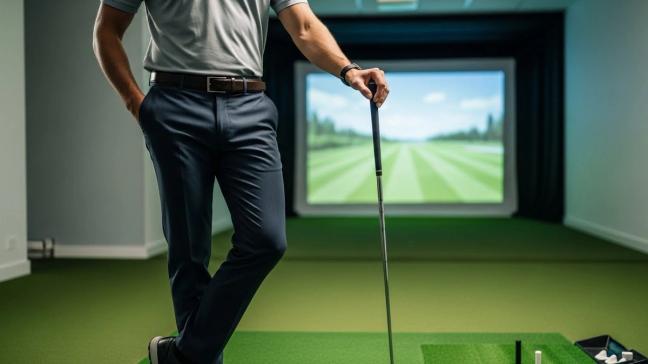
In the end, the case for simulators is disarmingly simple. They allow you to practise more often, with better information, in greater comfort, for less disturbance to the rest of your life. They make golf accessible when daylight, climate, geography or scheduling would otherwise conspire against it. They turn practice from an expedition into an ordinary activity.
Used seriously, they improve skills and maintain fitness. Used lightly, they provide sociable entertainment that still counts as something more valuable than time lost on a sofa.
For the modern player, the question is no longer whether simulators are a gimmick. It is whether you prefer your golf to be something the weather and the diary permit occasionally, or something that can be woven more reliably into the fabric of your week.
If you favour the latter, the glowing screen at the end of the room begins to look less like indulgence and more like infrastructure.
To receive the latest in style, watches, cars and luxury news, plus receive great offers from the world’s greatest brands every Friday.